/ 01
The short answer
Cool, frost free and just damp.
Here is how to store dahlia tubers over winter: lift them once the first frost has blackened the foliage, let them dry, then pack them in boxes of dry compost, sand or paper somewhere cool and frost free. The American Dahlia Society says most growers aim for 4 to 7°C (40 to 45°F). Check them once a month and throw out anything soft.
That is the whole method. The rest of this piece is the detail that decides how many come through, at the scale of a flower farm. The American Dahlia Society reckons any of the usual storage methods should bring 90 to 95% of good, mature tubers from healthy plants through the winter. The risks are bruising at lifting, which the RHS warns about, and stores that freeze, run warm or dry out, which the American Dahlia Society warns about.
| When to lift | Once the first frost blackens the leaves, not the morning after | RHS; National Dahlia Society |
| Cutting back | Stems down to 5 cm, or about 15 cm | RHS; National Dahlia Society |
| Drying | Upside down and frost free: whole clumps for a few weeks, divisions for a day or so | RHS; American Dahlia Society |
| Storing | 4 to 7°C (40 to 45°F), never freezing, ideally below 10°C (50°F) | American Dahlia Society |
| Checking | Once a month, throwing out anything rotting | American Dahlia Society |
/ 02
Timing
When to lift dahlias.
Wait for the frost, then wait a little longer. The RHS lifts dahlias once the foliage has been blackened by the first frost. The National Dahlia Society warns that lifting immediately after that first frost is a bad idea, because the tubers swell and mature after it, and the American Dahlia Society notes that roots keep maturing after light frosts. The frost is the signal to get the crates ready, not to grab the fork that morning.
Use the wait to decide what earns a bed next year. A clump of a variety that cut well all summer is worth dividing into several; a clump of one that sulked can go straight on the compost, which saves you storing it, checking it and planting it again. If you logged your cuts, that list starts from numbers rather than memory. In BloomOS, the cuts you logged give you yield per bed and profit per variety, and the stems that also lasted in the vase are worth a second look (more in how long dahlias last).
Some growers don't lift at all. The National Dahlia Society says that in milder parts of the country, on free-draining sandy soil, you can leave tubers in the ground under a mulch at least four inches (10 cm) deep. On heavy clay, it is safer to lift.
/ 03
Lifting
Dig, clean and dry.
Lifting is one of the bigger jobs on our winter list, and a lot of a tuber's chances are decided in the few minutes it is being dug. The RHS warns that cut or bruised tubers can rot in storage.
- Cut the stems down. The RHS cuts the old flowering stems to 5 cm; the National Dahlia Society leaves about 15 cm of stem. A longer stub gives you something to hold and somewhere to tie a label.
- Label before you dig. Once a clump is out of the ground, every variety looks the same. A tag on the stem, written in pencil, is cheaper than a winter of guessing.
- Fork wide. Start well out from the stem and lever the clump up rather than spearing it.
- Get the soil off. By hand, or gently with a hose if you plan to divide straight away.
- Dry them upside down. Stems to the ground, as the National Dahlia Society puts it, so any water in the hollow stems runs out, somewhere airy and frost free. Whole clumps take a few weeks, says the RHS. Divided tubers need about 24 hours, or 24 to 36 for medium and large ones, says the American Dahlia Society.
A bruised tuber in November can be a rotten one by February.
/ 04
Dividing
Now, or in spring.
You can divide clumps in autumn or in spring. The American Dahlia Society's case for autumn: clumps cut easily now, and some varieties go so hard over winter you would need a saw by spring. The case against: the eyes are hard to see this early. Its tip is to cut the tops off several days before you dig, so the eyes have time to show.
Every division needs a piece of the crown with an eye on it. A fat tuber with no eye will not make a plant, however healthy it looks.
If you have the room and not the time, store the clumps whole. Three Acre Farm, a flower farm in the US, keeps its clumps whole and divides in spring, finding they store better that way, at the cost of far more space.
Whichever you choose, label every division. The American Dahlia Society suggests an indelible pencil on the skin while it is slightly damp, a fine marker once it is dry, and a short code for long variety names, with one firm warning: do not lose the code. Its marking tip for an especially good tuber, the one you will take cuttings from, is a star.
/ 05
The store
How to store dahlia tubers through winter.
Cool, frost free and slightly damp is the whole brief. The American Dahlia Society explains why the range is narrow: freezing ruins tubers, and warmth brings fungus, rot and early sprouts. The RHS suggests a shed or a garage attached to the house, as long as it stays frost free. Two US flower farms, Three Acre Farm and Triple Wren Farms, aim for 80 to 90% humidity in the store.
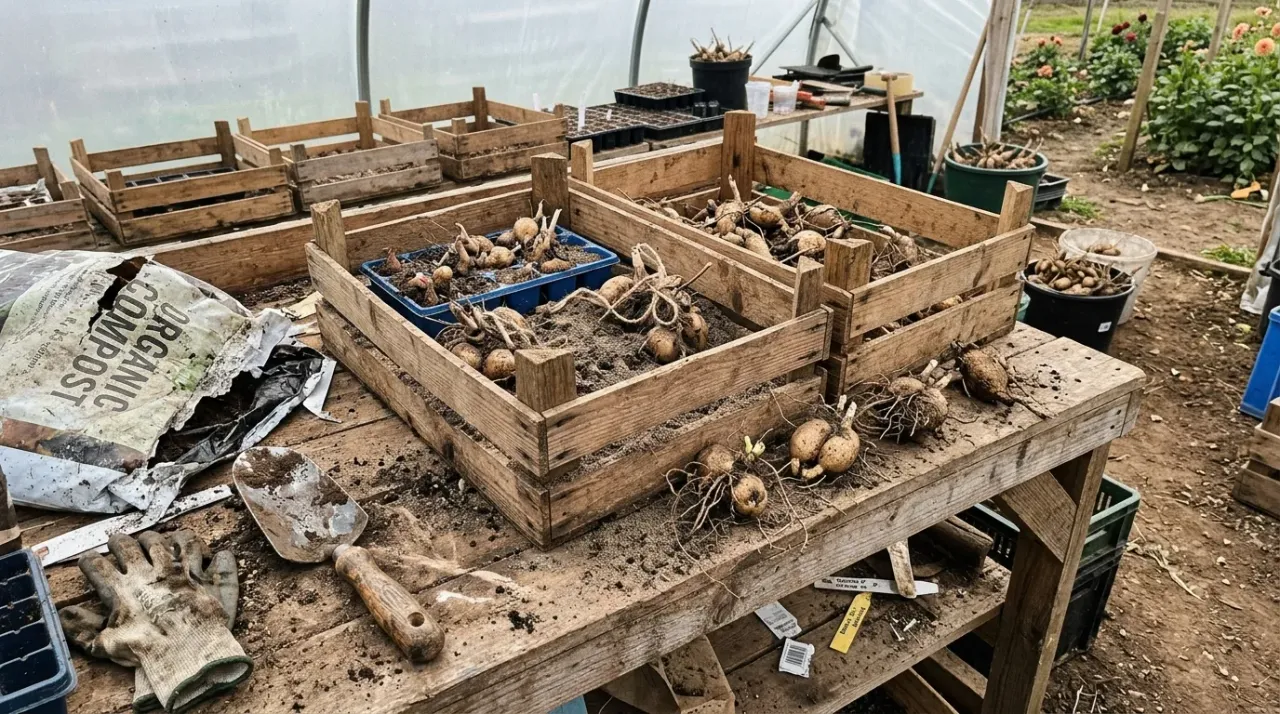
| Crates or wooden boxes of dry sand, soil or compost, stalks showing (RHS) | Whole clumps | Shrivelling, if the store is very dry |
| Boxes lined with newspaper at least eight sheets thick, lid closed (ADS) | Divisions | Shrivelling, if the lid is left off |
| Plastic bags with a damp medium (ADS) | Dry sheds and garages | Rot spreading between touching tubers |
Check the boxes on the first of every month, and a rotten tuber never gets the chance to spoil its neighbours.
Then check them once a month: put it in the diary for the first of each month until planting time. The American Dahlia Society's rules are simple:
- Soft or smelly? Throw it away now, before the rot spreads to its neighbours.
- Shrivelled? The store is too dry. A damper medium, or a closed box, helps.
- Sprouting in January? The store is too warm.
Say a 10 metre bed held 44 dahlias at 45 cm, the spacing in our plants per bed guide. If two thirds of the clumps are worth keeping and each gives four good divisions, that is about 117 tubers. At the American Dahlia Society's 90% or better, around 105 come through to spring: enough for more than two beds of dahlias, from one. Your divisions per clump will vary hugely by variety, so treat the four as an assumption, not a promise.
/ 06
Questions
What growers ask.
When should you lift dahlia tubers? Once the first frost has blackened the foliage. The National Dahlia Society advises against lifting immediately afterwards, because the tubers are still swelling and maturing.
What temperature should dahlia tubers be stored at? 4 to 7°C (40 to 45°F) is the range most growers aim for, according to the American Dahlia Society. Never let them freeze, and keep them below about 10°C (50°F) or they rot or sprout early.
Can you leave dahlias in the ground over winter? In milder areas on free-draining soil, often yes, under a mulch at least 10 cm (four inches) deep, says the National Dahlia Society. On heavy clay, lift them.
Should you divide dahlia tubers in autumn or spring? Either works. Clumps cut more easily in autumn, while eyes are easier to see in spring. Every division needs a piece of the crown with an eye.
How do you stop dahlia tubers rotting in storage? Dig without bruising them, dry them properly, keep them cool and slightly damp, and check them monthly, throwing out any soft ones before the rot spreads.
From the field
Know which dahlias earned their bed
BloomOS logs every cut from your phone, even with no signal, so by the first frost you know which varieties gave you the stems. Founding farms use it free for life.