/ 01
The problem
The notebook in your back pocket.
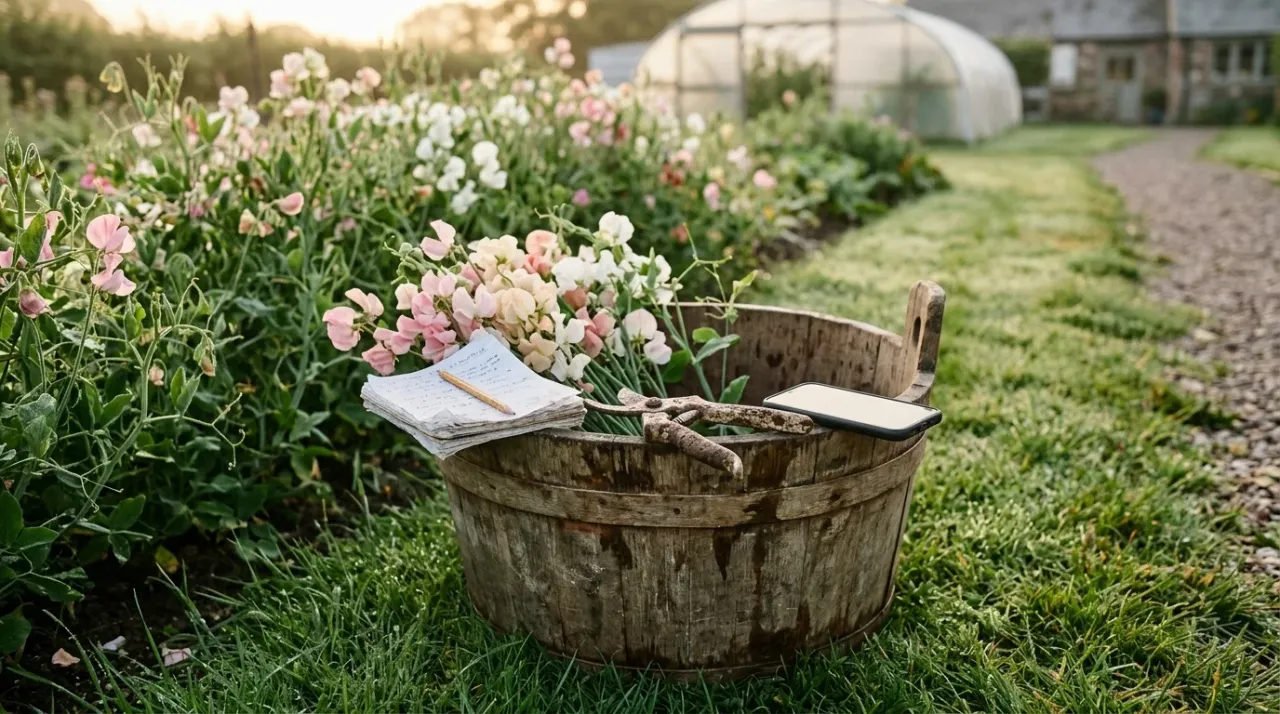
It is 5am in July, the dew is still on the sweet peas, and you have a bucket in one hand and snips in the other. The notebook is in your back pocket, which is exactly where it stays until you are back in the kitchen trying to remember whether bed 3 gave forty stems or fourteen.
BloomOS started with exactly this. In February 2026 Hannah came in from the field muddy, holding seedling counts written on paper that had gone soft in the rain, and said "we need an app". The counts were real work, and the paper had nearly lost them.
Most growers have their own version of that story. The counts get written on a seed packet, a hand, the back of an invoice. Then they get copied out late at night, or not at all, and by August nobody can say which bed of zinnias is actually paying its way.
A count you meant to write down is not a count. It is a guess with good intentions.
/ 02
What to record
Six things worth writing at every cut.
You do not need much. You need the same few things, every time, written at the bed rather than remembered later.
| Date | Shows when each crop peaks and fades | 14 July |
| Bed | Lets you work out stems per bed and per metre | Bed 3 |
| Variety | Tells one zinnia from another at review time | 'Benary's Giant Lime' |
| Stem count | The number everything else is built on | 40 |
| Quality | Separates sellable stems from seconds | 32 firsts, 8 seconds |
| Note | The thing you will forget by lunchtime | Mildew starting on lower leaves |
Date and bed are the ones people skip, because they seem obvious at the time. They are not obvious in November.
Variety, not just flower. "Dahlias, 60" tells you almost nothing. "Cafe au Lait, bed 7, 22" tells you which tubers to order again.
Quality is optional, but useful. Even a rough split between firsts and seconds shows which varieties give you stems you can sell at full price, and which mostly fill the compost bucket.
/ 03
The method
A cut log that survives a wet morning.
Whatever you write on, the method matters more than the tool. Here is the routine that works with paper, a phone spreadsheet or an app.
- Count at the bucket, not at the plant. Cut freely, then count what is in the bucket before you move to the next bed. Counting stem by stem as you cut slows you down and drifts.
- Count in tens. Group stems into tens as they go in, or band every ten. Ten bands of ten is far easier to count at 6am than a loose armful.
- One line per bucket, per bed. If a bucket holds two varieties, that is two lines. Mixing them is how counts become guesses.
- Write before you leave the bed. The walk to the next bed is where numbers go missing. Ten seconds at the bed beats ten minutes of remembering.
- Write the note now. Mildew, earwigs, short stems, a variety that has gone over. Your future self wants the note more than the number.
- Keep the log in one place. Not a notebook and a phone and the back of a seed packet. One place.
If you use paper, a waterproof notebook and a pencil (pencil writes on damp paper, most pens do not) will get you further than a fancy planner. If you use a spreadsheet, set it up with the six columns above before the season starts, so there is nothing to decide in the field. Our free crop planning spreadsheet has a place for this.
Save this: the cut log checklist
- Date, bed, variety, stems, quality, note
- Count at the bucket, in tens
- One line per bucket, per bed
- Write it before you walk away
- One log, never two
/ 04
What it tells you
Why the numbers matter in August, and in February.
A season of cut logs is the most useful thing a small flower farm owns. It answers the questions every grower ends up asking.
Here is a worked example, with the numbers made up to show the arithmetic. Say a 10 m bed of zinnias is cut twice a week for ten weeks and gives an average of 30 stems a cut. That is 600 stems from the bed. If you know that, you know what the bed is worth at your stem price, how many mixed bunches it supports each week, and whether it earned its space against the bed of snapdragons next to it. Without the log, you have a feeling.
Logged cuts also show the shape of the season. You see the week your sweet peas peaked, the July gap where nothing much was ready, and the fortnight in September when the dahlias gave more than you could sell. That is exactly what you need to get succession planting right next year.
And they feed the money side. Stems per bed is the first line of any honest profit per acre sum. Every other number sits on top of it.
Your cut log is next year's seed order, written one bucket at a time.
/ 05
In BloomOS
Thirty seconds, one hand, no signal.
We built the cut log for the moment it is actually used: standing at a bed, wet gloves, a bucket in the other hand and no phone signal at the bottom of the field.
One-handed, gloves on. The cut log uses a large keypad you can press with gloves on. You pick the variety, tap in the stem count, add a quality note if you want one, and that is it. Our own claim for a cut entry is done in 30 seconds.
Works with no signal. Cuts save to the phone and sync when you are back in range. You do not have to walk to the gate to find a bar of signal, and nothing is lost if the connection drops.
On any phone, today. BloomOS runs in the browser on any phone and can be added to the home screen like an app. A native iPhone and Apple Watch app is coming to the App Store.
No retyping. Because the count goes in at the bed, there is no evening session copying a notebook into a spreadsheet, and no second notebook for the things that did not fit the first. The same counts then feed profit per variety and yield per bed, so the August question and the February question are already answered.
Your data stays yours. You can export everything as spreadsheet files at any time, and we never sell your data.
/ 06
Getting started
Your first week of logging.
You do not need to log everything perfectly from day one. Start small and make it a habit.
- Week one: log stem counts only, for your two or three busiest beds.
- Week two: add the variety for every line, not just the flower.
- Week three: add a quality split or a note when something is worth noting.
- By the end of the month: every bucket, every bed, every time.
The aim is a log you trust enough to plan from. Once you have one season of it, our end-of-season review shows how to turn it into a decision about what to grow next year, and the variety library helps you choose what replaces anything that did not earn its bed.
From the field
Log the cut before the bucket is full.
The BloomOS cut log works one-handed, with gloves on and with no signal, and syncs when you are back in range. Founding farms use it free for life in return for honest feedback.