/ 01
Why now
Do it the week the frost arrives.
The first hard frost ends the season for the dahlias, the zinnias and the cosmos in a single night. It is also the best moment to look back, because you still remember which bed sulked in July and which variety you could not cut fast enough in September.
Leave it until February and memory has rewritten the season. The variety you loved looking at becomes the variety you grow again, whether it paid or not.
So be honest about the title. With a season of records in front of you, this review takes about ten minutes for a small farm. Without records, it takes longer, and the answers are softer. Either way it is worth doing.
The seed catalogue will always tell you what to grow. Only your own season can tell you what to grow again.
/ 02
The questions
Five questions for every variety.
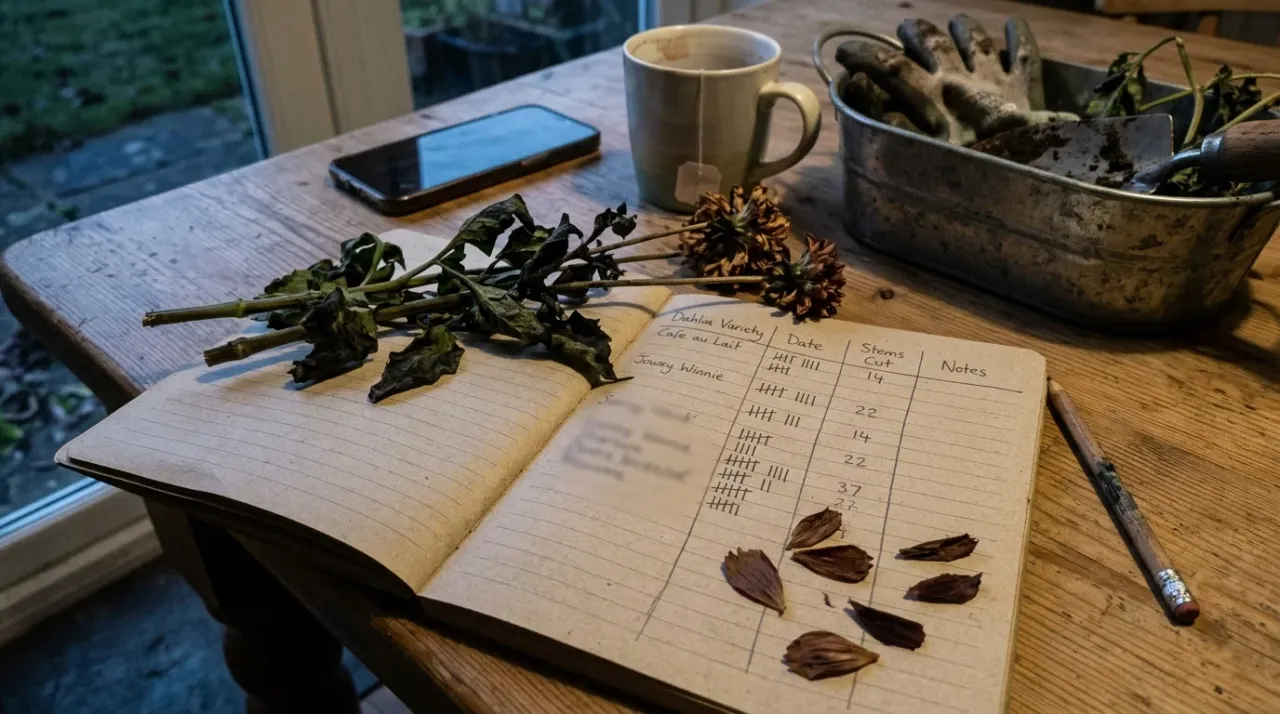
Go through your varieties one at a time, and ask each the same five questions. Write the answers on one line per variety.
- How many stems did it give? In total, and per bed or per metre if you can. This is the number everything else rests on.
- How many did you sell? Stems that went to the compost or into a free bunch for the neighbour do not count.
- What did it sell for? Your actual price per stem or bunch, not your list price.
- Did it hold up? In the vase and in the bucket. A variety that comes back as a complaint costs more than its stems. Our guide to how long cut flowers last has the published ranges to compare against.
- Did it fill a gap? Some varieties earn their place by flowering in the weeks when nothing else does, even if they are not the best sellers.
That fifth question matters. A bed of early sweet peas, with a vase life of only four or five days, can still be one of the most valuable things you grow if it is what you have to sell in June.
/ 03
The maths
Two beds, one worked example.
Here is a worked example to show how the numbers compare. Every figure is an assumption, chosen to make the arithmetic easy to follow, not a benchmark.
Say you grew two 10 m beds. One was zinnias, sown from seed. The other was a dinner-plate dahlia, grown from bought tubers.
| Stems cut over the season | 600 | 250 |
| Stems sold | 540 | 200 |
| Price per stem | 60p | £1.20 |
| Sales | £324 | £240 |
| Seed or tubers | £10 | £80 |
| Left after plant costs | £314 | £160 |
| Per metre of bed | £31.40 | £16.00 |
On these numbers the zinnias earned nearly twice as much per metre. That does not automatically mean drop the dahlia. The tubers can be lifted and kept, so next year's plant cost is lower. And if that dahlia is the one your wedding florist asks for by name, it may be bringing in orders the zinnias never would.
What the table does is stop the decision being a feeling. It also leaves out labour, which is often the biggest cost of all. If you want to include it, our pieces on flower farm labour and profit per acre show how.
/ 04
Verdicts
Keep, grow more, grow less, or drop.
Once every variety has its line, give each one of four verdicts. Be decisive. A bed is the scarcest thing on a small farm.
| Grow more | It sold out, held well and earned well per metre |
| Keep | It earned its bed, or it filled a gap nothing else could |
| Grow less | It sold, but you cut far more than you could sell |
| Drop | It earned little, held poorly, or caused complaints |
Write a reason next to each verdict. "Drop: mildew every August" will stop you buying it again in a weak moment in February.
Look for the gaps. List the weeks when you had too little to sell. Those weeks tell you what to look for in new varieties, and when they need to flower.
A variety you love but cannot sell is a hobby. That is allowed, as long as you know which is which.
/ 05
The seed order
From verdicts to February's order.
The review is only useful if it changes what you buy. Turn the verdicts into a draft order now, while the reasons are fresh.
Save this: the end-of-season checklist
- One line per variety: stems cut, stems sold, price, vase life, gap filled
- A verdict for each: grow more, keep, grow less, or drop
- A reason written next to every verdict
- A list of the weeks you were short of stems
- Tubers and bulbs to lift, store or reorder
- A draft seed order, with quantities, before the end of November
For the gaps and the replacements, the variety library lets you look up colour, stem length and vase life for 2,773 cut flower varieties before you commit to a packet. When you are ready to turn the order into a sowing plan, our free crop planning spreadsheet does the sums, and the winter jobs list covers what else to get done before spring.
/ 06
In BloomOS
Most of the review, already done.
The slow part of any review is gathering the numbers. If they have been collected through the season, the review itself is the quick part.
Profit per variety. BloomOS shows profit per variety, so you see what each one earned, not just how many stems it gave.
Yield per bed. Because cuts are logged against beds, you can see which beds and varieties gave the most stems for the space.
Best sellers by month. This shows the shape of your season, and the weeks where you were short.
More on the Farm plan. The Farm plan adds a profit and loss view and revenue per bed.
Your numbers, exportable. You can export everything as spreadsheet files at any time, if you would rather do the review in your own spreadsheet. Your data is never sold.
All of it depends on logging cuts through the season. If you are starting from scratch next year, our guide to logging a cut in 30 seconds shows the habit that makes this review a ten-minute job.
From the field
The review, mostly done for you.
BloomOS turns your cut log and orders into profit per variety, yield per bed and best sellers by month. Founding farms use it free for life in return for honest feedback.