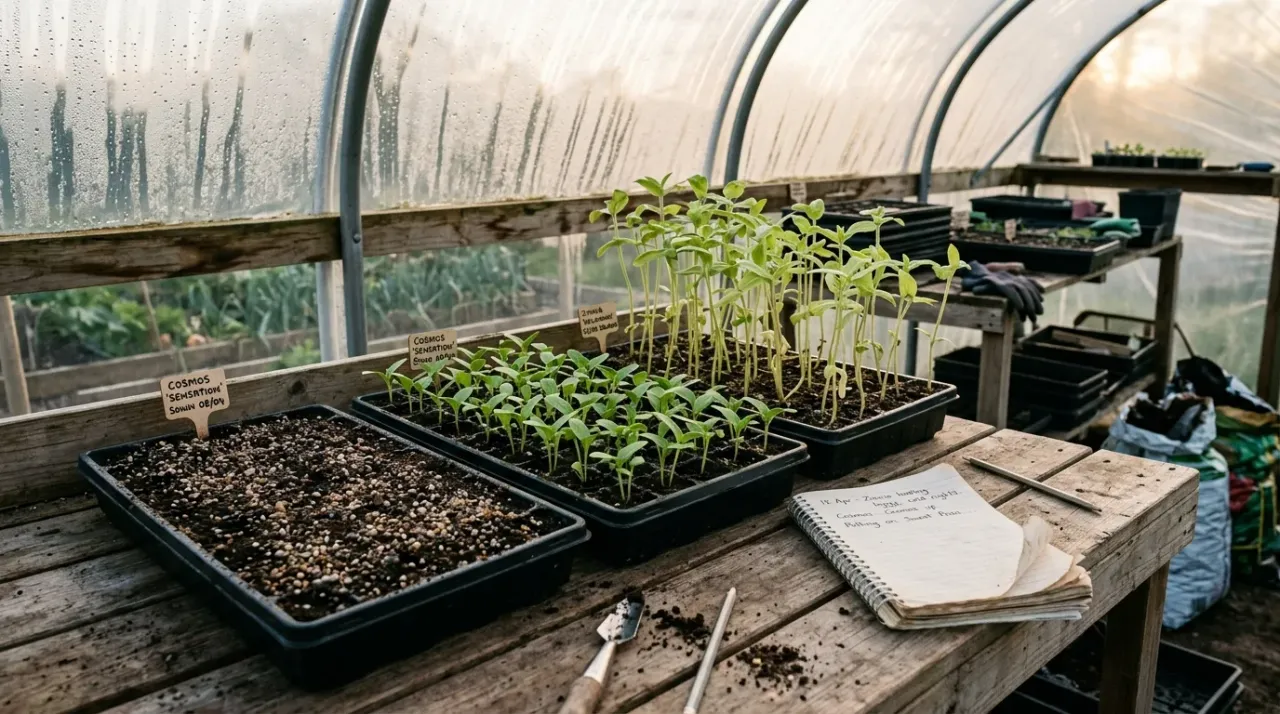
/ 01
The problem
The plan was perfect in February.
It is a February evening, the seed order is half done, and the spreadsheet has forty rows of beautiful intention: three sowings of cosmos, stocks every fortnight, sunflowers in waves until September.
Then the season starts. A cold April holds back the first tray of zinnias by a fortnight. A bed you had pencilled in for stocks is still full of tulips. You miss the late June sowing because a wedding ate the week. By July the spreadsheet describes a farm that does not exist, and rebuilding it on a Sunday night is the last thing anyone wants to do.
That is spreadsheet panic: not a lack of planning, but a plan that cannot keep up. Our guide to succession planting for cut flowers covers the why and the intervals. This piece is about the how: building a plan that survives contact with the weather, with or without software.
A crop plan is not a document. It is a conversation with the season, and the season talks back.
/ 02
The method
Plan backwards from the cut.
The single biggest change you can make is to stop planning forwards from sowing dates and start planning backwards from the week you want to cut.
Forward planning asks "when shall I sow?" and gets an answer from habit. Backward planning asks "when do I need these flowers in the bucket?" and works out the rest. It is the same arithmetic, pointed the right way round.
For each crop, you need four numbers:
- The first week you want to cut it. From your sales: when the market opens, when the florists start asking, when the weddings are.
- Days to flower. From the seed packet or catalogue, then corrected by your own records.
- How long one sowing keeps cutting. A single-stem sunflower gives one cut; a well-picked cosmos gives weeks.
- Your first frost date. The hard stop that tells you when the last sowing stops being worth the compost.
From those four, every sowing date falls out. Here is a worked example, with the assumptions shown so you can swap in your own.
| First market week wanted | early July (assumption) |
| Days from sowing to cut | about 70 (assumption, check your packet) |
| Cutting window per sowing | about 2 weeks (assumption) |
| First sowing | late April, 70 days before early July |
| Following sowings | every 2 weeks, to match the cutting window |
| First frost | mid October (assumption) |
| Last worthwhile sowing | early August, 70 days before frost |
Notice the cutting window sets the sowing interval. If one sowing cuts for two weeks, you sow every two weeks. If your records later show that variety cuts for three, you stretch the interval and save trays. That is the whole trick, and it is why the interval table in our succession planting guide puts single-flush crops at every two weeks and cut-and-come-again crops at two or three sowings a season.
/ 03
Keeping it alive
What to do when the season slips.
No plan survives April intact. The useful question is not "did it go to plan?" but "what does the plan need to know?"
Three things go wrong every year, and each has a simple response.
- A sowing fails or germinates badly. Resow straight away if there is time before your last worthwhile sowing date; skip it if there is not. A poor tray planted anyway takes a bed for weeks and gives little back.
- Everything is late. A cold spring delays the first sowings, but later sowings often catch up, because they grow in warmer weather. Do not push every date back. Note the delay, and watch what the second sowing does.
- A bed is not free when planned. Have one or two spare transplants ready, or a quick crop (a foliage filler, a fast annual) that can wait in modules for a week or two without sulking.
The thing that makes all three manageable is writing down what actually happened, as it happens: the sowing date, how many came up, the date it went out, the date of the first cut. That is the record that makes next February's plan better than this one.
Next year's plan is written by this year's mistakes, but only if somebody wrote them down.
Save this: the weekly succession check (five minutes, Monday morning).
- What is due to be sown this week, and is there space on the bench?
- What is due to be planted out, and is its bed actually clear?
- Did last week's sowings come up? Note the count.
- Which crops are cutting now, and when does each one tire?
- Are you still before the last worthwhile sowing date for each crop?
/ 04
The spreadsheet
Why it works in winter and fails in June.
To be fair to the spreadsheet: it is a good place to start, and we make a free one. Our crop planning spreadsheet has a succession planner where you enter the variety, the interval and the first sowing date, and it lays the season out for you.
Where spreadsheets struggle is the rest of the season. They sit on a laptop indoors, while the decisions happen at the potting bench and in the bed. They do not know a sowing slipped unless you tell them. They do not know which bed is free. And they keep the plan and the outcome in different places, if the outcome is kept at all.
| Laying out a season in winter | Good | Good |
| Seeing what is due this week, in the field | Hard on a phone | Built for the phone |
| Knowing which bed is planted with what | A separate tab | Bed maps |
| Recording germination | Another column to remember | Germination tracking |
| Linking a sowing to what it cut | By hand | From the cut log |
| Cost | Free | Free Seedling plan |
/ 05
The BloomOS way
One plan, from the bench to the bucket.
BloomOS season planning puts the sowing schedule, the successions, the bed maps and germination tracking in one place, on the phone in your pocket at the potting bench.
You set up your successions once. Each week the plan shows what is due. When a tray comes up, you note the germination. When a sowing goes out, it lands on a bed in the bed map, so you are not guessing which bed is free in June. When you start cutting, the cut log records stems by variety, which means the question "what did the third sowing actually produce?" has an answer at the end of the season, without anyone retyping a notebook.
And because frost and heat alerts in BloomOS are linked to the specific beds and crops you have planted, the weather that bends the plan arrives as a note about your beds, not a forecast you have to translate. More on that in frost alerts for the beds you actually planted.
It will not choose your crops or decide your cut dates. Those come from your sales and your farm. What it removes is the Sunday-night rebuild: the plan, the beds and the results stay in one place, so the plan can change as fast as the season does.
/ 06
Getting started
Start with three crops, not forty.
If your plan is forty rows of intention, cut it down. Choose the three crops that earn most, or that customers ask for most, and plan those backwards from the cut properly this season. Record what each sowing did. Next winter, those three will be the best-planned crops on the farm, and you can add three more.
Then, whatever you use, put the plan where your hands are. A clipboard on the potting shed wall beats a perfect spreadsheet on a laptop nobody opens in June. If you would like the same plan on your phone, with the beds and cuts joined up, the BloomOS Seedling plan is free for ever, and we are recruiting a small group of founding farms who use it for a full season and tell us honestly what works.
From the field
Plan once, then let the season talk back.
BloomOS season planning covers sowing schedules, succession planning, bed maps and germination tracking, on any phone. The Seedling plan is free for ever, and founding farms are free for life.