/ 01
The short answer
Cut, lift, keep cold and frost free.
Overwintering chrysanthemums is simple: once flowering has finished, cut the stems down to about 20 cm to make a stool, lift it, and keep it somewhere cold but frost free in a tray of just-damp compost. That is the RHS method. In early January you can bring the stools into a little warmth to make shoots for cuttings, which become next summer and autumn's plants.
Chrysanthemums are tougher than dahlias, but not tough enough to rely on everywhere. The RHS says most hardy chrysanthemums survive down to at least -5°C, and that in much of the UK temperatures can drop below that, so lifting and storing is the safer choice.
| When | Once flowering has finished, late autumn | RHS |
| Cut back | Stems to about 20 cm, making a stool | RHS |
| Lift and clean | Shake off soil, snip off green shoots and leaves | RHS |
| Store | Tray with 5 cm of slightly damp compost, roots lightly covered | RHS |
| Where | Cold but frost free: cool greenhouse, conservatory or garage | RHS |
| Water | Keep compost just moist | RHS |
| Wake up for cuttings | Early January, greenhouse at 7 to 10°C | RHS |
/ 02
Cutting back
Making a stool.
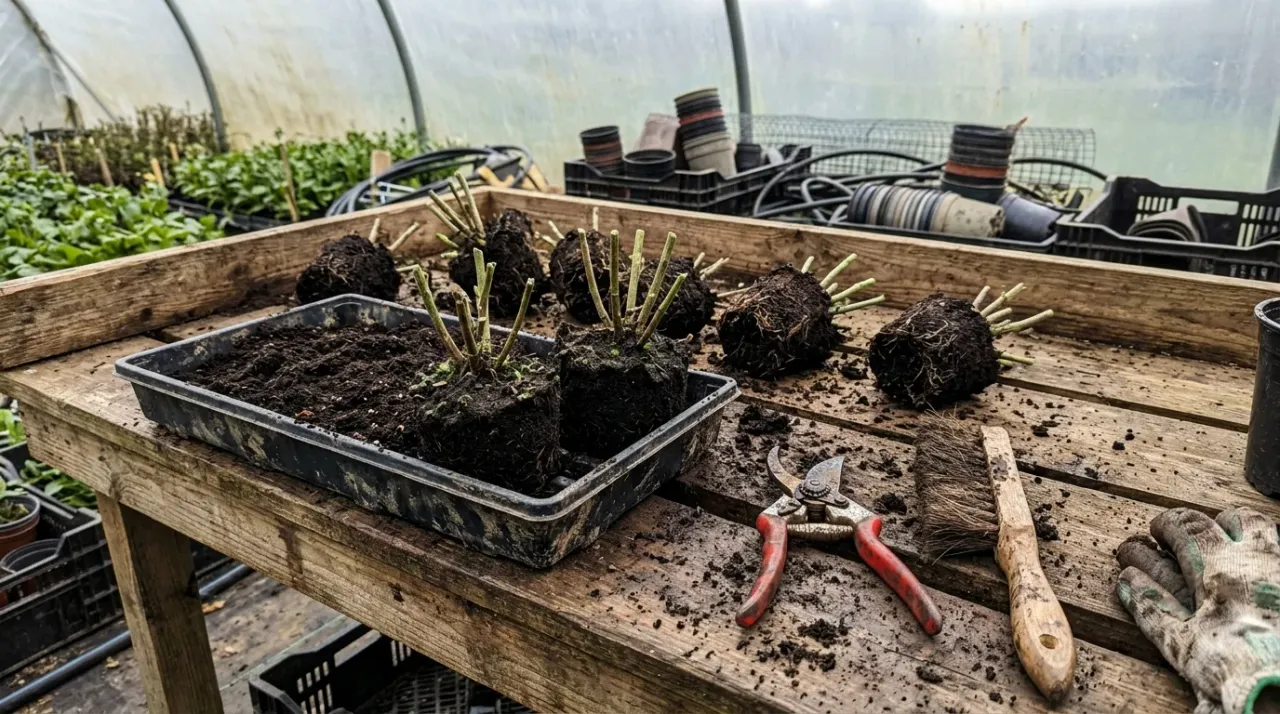
When the last stems are cut, cut the whole plant down to about 20 cm. The RHS calls what is left a stool: a short woody base with roots, from which next year's shoots will grow.
- Cut every stem to about 20 cm. Use clean, sharp secateurs.
- Lift the plant and shake the soil off the roots.
- Snip off any green shoots and leaves, so you are left with bare stems. The RHS advises this, so the stool goes into winter as bare stems.
- Label each stool. Chrysanthemum stools all look the same in February, and a mixed-up variety means a season of the wrong colour for a florist.
This is also the moment to be ruthless. Keep the stools of varieties that cut well, sold well and lasted in the vase (the vase life figures we use put chrysanthemums at 7 to 14 days, in our guide to how long cut flowers last). A variety that gave you a handful of short stems does not need a place in the store.
The stools you keep in November decide the colours you can sell next October.
/ 03
The store
Cold, light and just damp.
The RHS stands the stools in a shallow tray on a 5 cm layer of slightly damp compost, covers the roots lightly with loose compost, and keeps them in a cold but frost-free place, such as a cool greenhouse, conservatory or garage. The compost stays just moist through the winter.
Note the difference from dahlias. A dahlia tuber wants dark and nearly dry; a chrysanthemum stool is a living plant that stays slightly damp and does better with some light. The RHS describes the ideal as light, frost-free conditions.
Frost free means a minimum of 4°C. The RHS defines a frost-free greenhouse or conservatory as one with a night-time minimum of 4°C (39°F).
Not warm. A heated room will push the stools into soft, weak growth months too early.
Check them every few weeks. Pick off any mouldy bits, and make sure the compost has not dried out or turned soggy.
Keep an eye out for leafy gall. The RHS lists chrysanthemums among the plants most often affected. If a stool throws a dense cluster of short, distorted shoots, read our post on crown gall and leafy gall before you take cuttings from it.
/ 04
Leaving them in
Only in mild, sheltered spots.
If your winters rarely go below -5°C and the soil drains well, the RHS says you could risk leaving hardy chrysanthemums in the ground. Even then it suggests covering the root zone with an insulating mulch, and a cloche to keep off winter rain.
Plants in pots are more vulnerable, because the roots have no soil around them. The RHS says to bring potted chrysanthemums under cover once flowering has finished. In very mild areas, you could leave them out in a sheltered spot by a wall, with the pot wrapped in fleece and raised on pot feet so the compost does not waterlog.
| Tender or late types, in a tunnel | Cut back and lift, or keep in the tunnel if it stays frost free |
| Hardy types, mild area, free-draining soil | Leave in, mulch the roots, cloche against rain |
| Hardy types, cold area or heavy soil | Cut back and lift |
| In pots | Bring under cover once flowering ends |
/ 05
Spring
Turning stools into cuttings.
This is where a few stools become a full bed. The RHS takes basal softwood cuttings from the vigorous new shoots in spring, and says they root quickly and reliably to make plants that flower in late summer.
For a head start, the RHS brings stools out of storage in early January into a greenhouse at 7 to 10°C (45 to 50°F), waters the compost thoroughly, then keeps it just moist. Cuttings from these can be months ahead of outdoor plants.
- Wait for strong new shoots coming from the base, not from the old stems.
- Take shoots 5 to 7.5 cm long from the outside of the clump, cutting right at the base, as close to the crown as you can, says the RHS.
- Strip the lower leaves and push the cuttings into pots or cell trays of compost.
- Keep the compost moist, never soggy, until they root.
- Label every tray with the variety.
Count the cuttings you will need before you start. If you know how many plants fit in a bed, you know how many cuttings to take, and our plants per bed calculator works that out from your bed length and spacing.
One healthy stool in January can be a tray of cuttings by March.
/ 06
Questions
What growers ask.
When should I cut back chrysanthemums? Once flowering has finished in late autumn. The RHS cuts the whole plant down to about 20 cm.
Can chrysanthemums stay in the ground over winter in the UK? Hardy types can in mild, sheltered gardens with well-drained soil, says the RHS, with a mulch over the roots. In colder areas, lifting is safer.
How do you store chrysanthemum stools? In a shallow tray on 5 cm of slightly damp compost, roots lightly covered, somewhere cold but frost free such as a cool greenhouse or garage. Keep the compost just moist.
When can I take chrysanthemum cuttings? In spring, from strong new shoots at the base. For earlier cuttings, the RHS brings stools into a greenhouse at 7 to 10°C in early January.
Should chrysanthemum stools be kept in the dark? No. Unlike dahlia tubers, they do better in light, frost-free conditions, as the RHS describes.
From the field
Know which mums earned a bench
BloomOS logs every cut by variety and bed, even with no signal, so you can see which chrysanthemums paid for their tunnel space before you take cuttings. The Seedling plan is free for ever.