/ 01
The short answer
Pointed and separate is healthy. Clustered or knobbly is not.
Is this gall on my dahlia tuber? A healthy crown has one to several separate eyes that grow into pointed shoots. Leafy gall shows as a dense cluster of short, distorted, leafy shoots, often near ground level. Crown gall is a knobbly swelling or tumour on the crown or roots. If you see either of the last two, the clump should not be stored, divided or sold.
We cannot diagnose a photo, and neither can a Facebook group, however experienced. What we can do is set out what the reliable sources say each one looks like, so you can look at your own clump with a clearer eye. Two different bacteria are involved, and they behave differently.
| Healthy eyes | 1 to several separate buds, pointed tips | Normal growth | Wild Horse Gardens |
| Leafy gall | Dense clusters of distorted leafy shoots, often near ground level; fused or flattened stems | Rhodococcus fascians | RHS |
| Crown gall | Knobbly swellings on stems or roots | Rhizobium radiobacter (Agrobacterium tumefaciens) | RHS |
/ 02
Healthy eyes
What normal looks like.
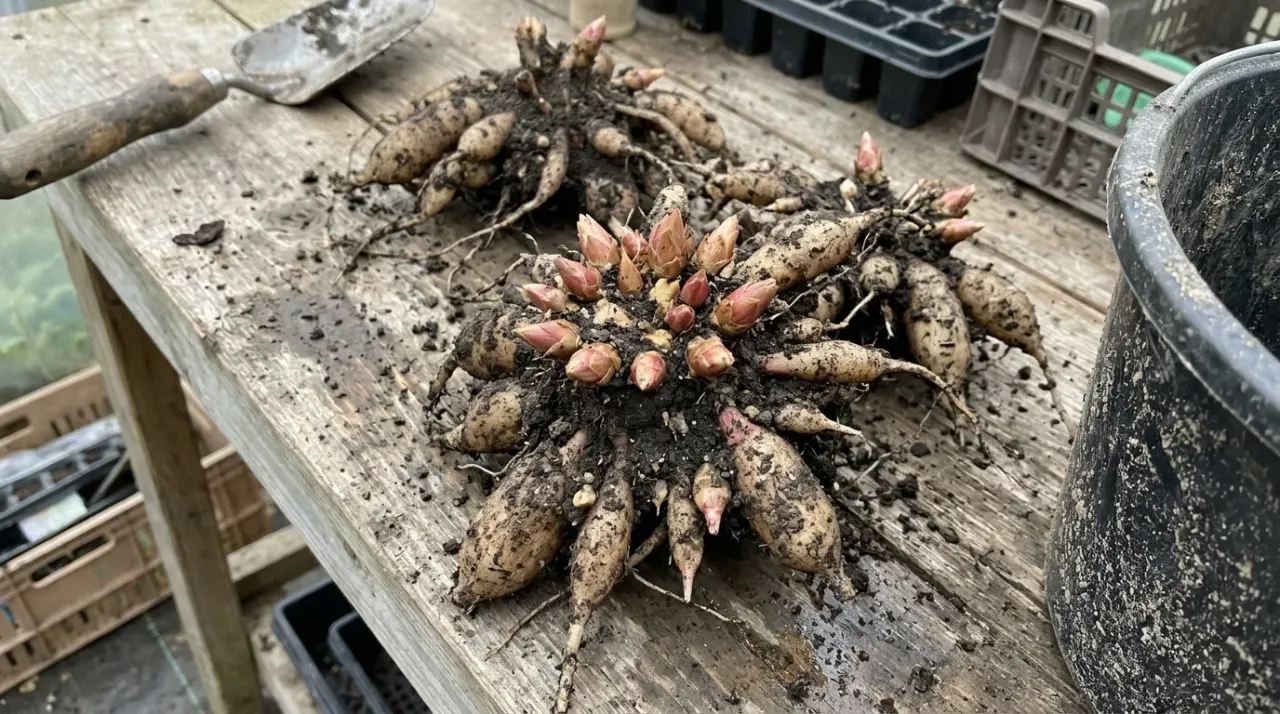
It helps to start with what you hope to see. Wild Horse Gardens, a US dahlia grower that has written a detailed series on dahlia disease, describes a normal eye as having a slightly pointed tip, the growing point, and says a healthy tuber has one to several eyes that are isolated from each other. As they grow, the shoots take on a pointed shape to push the soil away.
Two things often get mistaken for gall in lifting photos.
Early sprouts. If clumps have sat somewhere warm, or the autumn has been mild, eyes can start to sprout. A few separate green or pink shoots from the crown, each with its own pointed tip, is normal growth.
Bits in the compost. White, lumpy bits stuck around the crown of a pot-grown dahlia are often perlite from the potting mix. Wash the clump and look again before you worry.
Healthy eyes are few and separate. Gall is many and crowded.
/ 03
Leafy gall
The cauliflower look.
The RHS describes leafy gall as a disease caused by the bacterium Rhodococcus fascians, which enters through wounds in roots or stems and makes the plant tissue grow in a disorganised way. The symptoms it lists are dense clusters of distorted leafy shoots, often close to ground level, and flattened stems. Dahlias, chrysanthemums and sweet peas are among the plants most commonly attacked.
Wild Horse Gardens goes further on what it looks like on a dahlia crown:
- Sprouts that are rounded, curled or jagged, rather than pointed, short, with leaf buds tightly packed up the stem.
- Far more sprouts than normal, sometimes dozens of thin, pale, hair-like shoots with no main stem.
- Small pea-like lumps where a sprout is trying to come through.
- Fused eyes and stems in bad cases, looking knobbly and chunky.
How seriously to take it depends on what you do with your dahlias. The RHS says leafy gall is seldom serious enough to warrant control in a garden, and that there are no chemicals available for it. Its advice, if it is troublesome, is to sterilise pots, surfaces and tools carefully.
For anyone who divides, propagates or sells tubers, Wild Horse Gardens takes a harder line: the bacteria live on the surface of the plant and spread on gloves, snips, spades and water, and taking cuttings from an infected plant means the bacteria can be on every cutting. It advises throwing the whole plant out, including tubers on the side that looks clean, and not composting it.
/ 04
Crown gall
The knobbly swelling.
Crown gall is caused by a different bacterium, Rhizobium radiobacter, formerly Agrobacterium tumefaciens. The RHS describes it as knobbly swellings (galls) on stems and roots, and lists dahlia among the plants it affects. On herbaceous plants like dahlias, the galls decay and soon fall apart, and the bacteria return to the soil, where they can survive for long periods.
The Pacific Northwest Plant Disease Handbook says crown gall was considered rare on dahlias until the early 2020s, when it became a problem in the industry. It explains why it matters so much: the gall disrupts the plant's water and food transport, and most notably it stops new shoots forming from the crown, which is exactly where next year's plant comes from.
| Store or divide it? | No, if you propagate or sell | No |
| Compost it? | No (Wild Horse Gardens) | No: remove and destroy (PNW Handbook) |
| Clean tools? | Yes: sterilise tools and pots (RHS) | Yes: disinfect frequently (PNW Handbook) |
| Replant dahlias in that spot? | Clean up thoroughly first | Rotate: at least 2 years (PNW Handbook) |
| Chemical cure? | None available (RHS) | None for existing galls (PNW Handbook) |
The RHS suggests that after removing an affected plant, growing potatoes or other vegetables, except beetroot, for one or two years helps clear the bacteria from the soil, or grassing the area over.
A gall is not something to cut out and hope. The clump goes, the tools get cleaned, and the bed gets a rest.
/ 05
Prevention
Clean stock and clean tools.
Both bacteria get in through wounds, so most prevention comes down to care and hygiene.
- Buy from growers you trust, and inspect every tuber when it arrives. The PNW Handbook says not to plant anything with galls.
- Avoid wounding plants, especially at planting and lifting.
- Clean tools between clumps. Wild Horse Gardens suggests a 10% bleach solution or other disinfectant with a soak of at least five minutes, since a quick wipe only reduces the bacteria. The American Dahlia Society already advises sterilising cutting tools after each clump, at one part bleach to ten parts water, to stop virus spreading.
- Keep records of where each variety grew. If gall turns up, you want to know which bed it came from and which stock went where.
That last point is where a simple record pays. In BloomOS every variety sits in the bed you planted it in, with pest watch in its growing notes, so a problem can be traced back. Our guide to storing dahlia tubers covers the rest of the lifting season, and you can look up any variety in the dahlia library.
/ 06
Questions
What growers ask.
What does leafy gall look like on dahlias? Dense clusters of short, distorted, leafy shoots near the crown, sometimes with fused or flattened stems, according to the RHS. It is often described as looking like cauliflower.
What is the difference between crown gall and leafy gall? They are different bacteria. Crown gall makes knobbly swellings on stems and roots; leafy gall makes masses of distorted shoots. Both enter through wounds.
Can you save a dahlia tuber with gall? Growers who divide or sell tubers generally say no: discard the whole clump and do not compost it. The RHS notes there are no chemicals to control leafy gall.
Is dahlia gall in the soil? Crown gall bacteria survive in soil for long periods, says the RHS, so rest the bed from dahlias. Leafy gall spreads mainly on tools, hands, water and infected stock.
Are lots of sprouts on a dahlia tuber a sign of gall? Not always. A few separate, pointed sprouts are normal, especially in a warm store. A dense mass of short, crowded, distorted shoots is the warning sign.
From the field
Keep a record of every variety
BloomOS keeps each variety with its growing notes and pest watch, and logs your cuts by bed, so you know where every clump came from. The Seedling plan is free for ever.