/ 01
The idea
A second season from the same summer.
Every grower knows the November feeling: the first frost takes the dahlias, the beds go black, and the income stops just as Christmas arrives. Everlastings are the answer that has been hanging in farm sheds for generations.
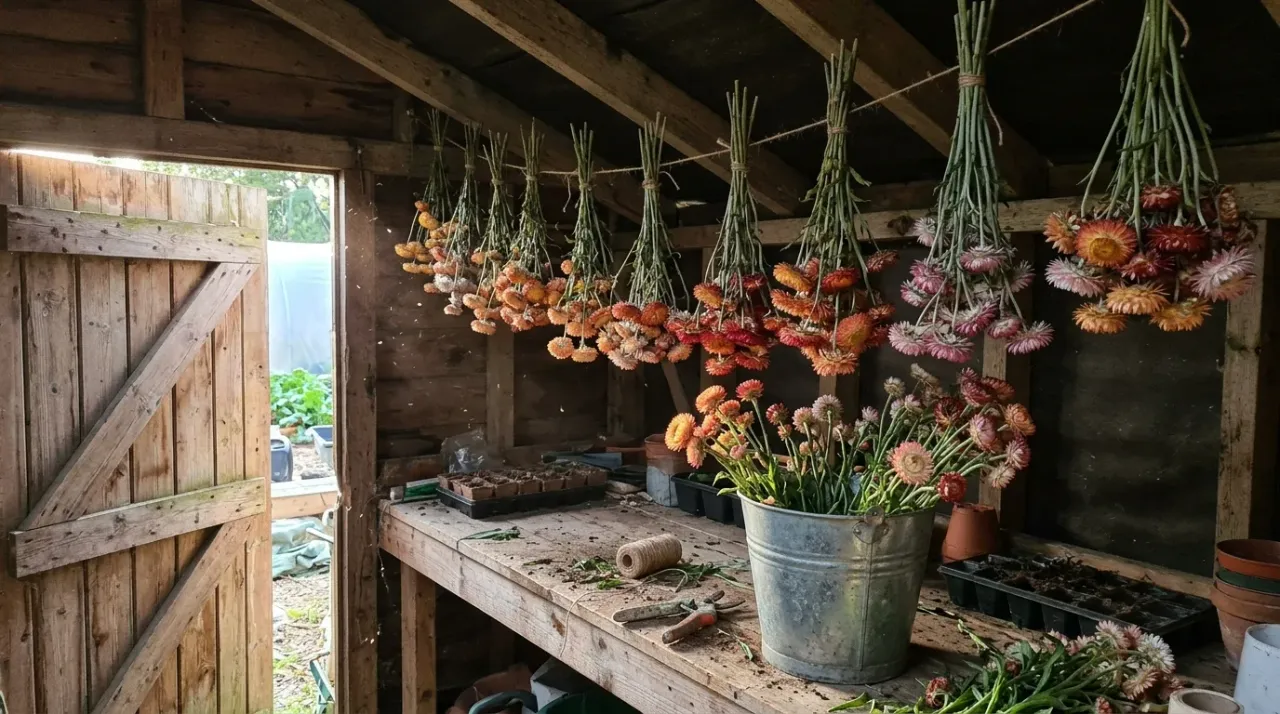
These are flowers, seed pods and grasses that hold their shape and much of their colour when dried. Cut in summer and hung in the dark, they become winter bunches, wreaths, buttonholes and dried wedding work, sold in the months when nothing fresh is coming out of the field. Many of them also make good fresh flowers first, so a single bed earns twice.
Fresh flowers sell for a week. Everlastings sell for a winter.
/ 02
The flowers
Fifteen classic everlastings.
These are the papery flowers, the ones that were born to dry. Most are easy annuals from a spring sowing.
- Strawflower. The everlasting most people picture. Papery bracts in every warm colour: 'Apricot', 'Copper Red', 'Silvery Rose', 'Vintage White' and the 'Swiss Giants Mix'. 7 to 14 days fresh, and the colour holds for months when dried.
- Statice. The classic filler. 'QIS Apricot', 'Misty Blue', 'Turbo Blue' and 'Forever Gold'. The colour sits in the papery calyx, so it barely fades. 7 to 10 days fresh.
- Gomphrena. Clover-like globes that last 14 to 19 days fresh and dry with very little colour loss. 'QIS Orange', 'Audray Pink', 'Fireworks' and 'Strawberry Fields' (sold as globe amaranth).
- Celosia. Plumes and crests in jewel colours, 10 to 14 days fresh. 'Sylphid' brings soft pastel plumes; 'Bombay' and 'Chief' give the bold crests.
- Winged everlasting. Small white daisies on curious winged stems, long-lasting fresh and lovely dried.
- Paper daisy (rhodanthe). Pink and white papery daisies from Western Australia.
- Billy buttons (craspedia). Golden drumstick globes that look the same dried as they do fresh.
- Globe thistle. Steel-blue spheres. 'Taplow Blue' and 'Veitch's Blue' both dry well.
- Sea holly. Spiky silver-blue collars. 'Big Blue', 'Blue Hobbit' and 'Sirius Questar'.
- Yarrow and achillea. Flat plates in 'Terracotta', 'Paprika' and 'Salmon Beauty'.
- Larkspur. Tall spikes in blue, pink, white and the antique 'Earl Grey'. About 7 days fresh, and a dried favourite.
- Lavender. 'Grosso', 'Provence' and 'Hidcote'. Dries with its scent intact.
- Hydrangea. 'Limelight', 'Annabelle' and the mopheads. Left on the plant to age, they dry into antique greens, pinks and parchment tones.
- Amaranth. Trailing tassels and upright spikes: 'Hot Biscuits', 'Emerald Tassels' and 'Hopi Red Dye'. Note that green amaranths such as 'Viridis' fade towards straw once dried.
- Bells of Ireland. Lime-green bracts on tall spikes that hold their colour when dried.
/ 03
Pods and grasses
The texture that makes a dried bunch look rich.
A dried bunch made only of papery flowers can look like a seed packet. The pods and grasses are what give it movement and depth.
- Love-in-a-mist pods. 'Albion Black Pod', 'Albion Green Pod' and 'Miss Jekyll' give flowers in early summer and inflated striped pods afterwards. See the love-in-a-mist varieties.
- Poppy seedheads. Grey-green architectural pods; 'Hens and Chicks' and 'Giganteum'.
- Honesty. 'Silver Dollar' and 'Chedglow' (a biennial, so sow this year for next) make the translucent silver discs.
- Scabious pods. 'Ping Pong' and 'Paper Moon' dry into papery honeycomb spheres.
- Chinese lanterns. Orange lanterns in autumn, ready made for Christmas.
- Bunny tails. Soft cream tufts that children cannot leave alone.
- Quaking grass and hare's tail. 'Maxima' quaking grass dangles and moves; hare's tail gives soft, upright plumes.
- Wheat, broom corn and ornamental millet. Autumn texture for wreaths and big dried pieces. 'Black Amber' and 'Hopi Red' broom corn, 'Purple Baron' millet.
- Eucalyptus. 'Silver Dollar' and 'Silver Drop' air-dry well and keep the bunch smelling clean.
/ 04
How to dry
Cut at the right moment, hang in the dark.
Drying is simple, but the cut stage matters as much as it does for fresh flowers. Cut too late and many everlastings shatter or go brown in the shed.
| Strawflower | outer bracts open, centre still closed | they keep opening as they dry |
| Statice | most of the spray is coloured | the colour is in the papery calyx |
| Gomphrena | globes fully coloured and firm | cut the whole stem, then hang |
| Celosia | plume or crest fully developed, before seed sets | strip the leaves first |
| Larkspur | half to two-thirds of the spike open | the open florets drop if left later |
| Lavender | the first florets just open | colour and scent hold best |
| Globe thistle and sea holly | full colour, before the florets open | late globes fall apart |
| Hydrangea | late in the season, when the heads feel papery | they finish drying in a vase |
| Nigella and poppy pods | pods firm and full | leave a few for next year's seed |
| Honesty | pods dry on the plant | rub off the outer skins for the silver |
Save this: the drying checklist.
- Cut on a dry day, after the dew has gone.
- Strip the leaves; they hold moisture and go mouldy.
- Make small bunches, five to ten stems, so air reaches the middle.
- Tie with a rubber band, not string. Stems shrink as they dry and string lets them fall.
- Hang upside down in a dark, dry, airy place. Light fades colour, damp invites mould.
- Leave them until the stems snap instead of bending.
- Store in boxes, out of the light, until you need them.
Every hour of sunlight on a drying bunch is colour you will never get back.
/ 05
Selling
What everlastings become in winter.
Dried flowers turn the quiet months into something you can sell. A few ideas that suit a small farm:
Dried bunches and jars. A mixed bunch of strawflower, statice, nigella pods and bunny tails is the simplest product, and it keeps. Use the same palettes you used in summer; our colour palettes guide works for dried stems too.
Christmas wreaths. Hydrangea heads, lanterns, eucalyptus, wheat and poppy heads on a wreath base. A wreath workshop in late November is another way to turn the shed into income.
Dried wedding work. Buttonholes, hair combs and keepsake bouquets for winter weddings and for couples who want something to keep.
Florist stock. Florists building dried installations want straight colour and long stems, so keep some bunches of a single variety rather than mixing everything.
A word on price: dried stems have had more handling than fresh ones (cutting, stripping, bunching, hanging, storing) and lose some weight and size in the process. Price for that work, not for the stem count alone. If you want the reasoning in more detail, our piece on flower farm labour looks at where the hours go.
/ 06
Planning
Grow a drying bed on purpose.
The best dried stems come from a bed planned for drying, not from whatever was left in the field in September.
Sow extra. Strawflower, statice, gomphrena and celosia all want a spring sowing and a warm summer. Put in a few more than you need for fresh sales, and cut the extras for the shed.
Cut on schedule. Everlastings, like fresh flowers, have a window. A bed of strawflowers cut every few days gives you a shed full of perfect heads; one cut once at the end gives you a shed full of open, fluffy centres.
Write it down. How many stems you hung, of which variety, and how many came out of the shed good enough to sell. Logging the cut as you go means a stem count and a quality note for every variety, so by March you know which everlastings paid for their bed and which became compost. If you want to plan the drying beds alongside everything else, our free crop planning spreadsheet has a place for it.
From the field
Know what you dried, and what sold.
Log every cut from the phone in your pocket, with stem counts and a quality note, even with no signal. BloomOS keeps the record, so next spring you know which everlastings earned a bed.