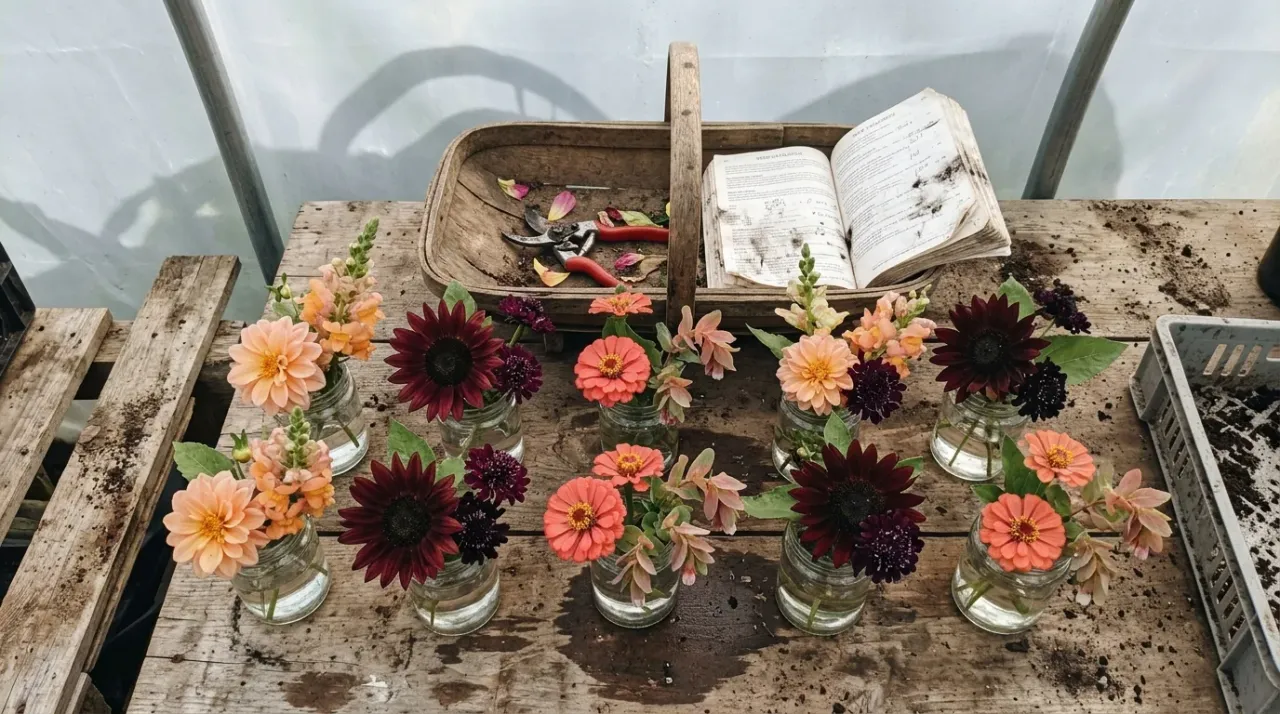
/ 01
Why palette
People buy a colour before they buy a flower.
Most customers do not know the difference between a zinnia and a dahlia, and they do not need to. What they know is that they want something soft for a new baby, something bright for a birthday, or "the colours of my wedding". A palette answers the question they are actually asking.
For a grower, a palette is also a discipline. It turns a field of everything into a few combinations that work together, which makes bunching faster at 6am, makes the stall look intentional, and makes it much easier to say yes to a florist who asks for "peach and cream, with something dark".
A field of everything makes a stall of nothing in particular. A palette makes a stall people photograph.
/ 02
The rule
One lead, one echo, one contrast, one rest.
You do not need colour theory to build a palette that sells. You need four jobs filled.
- The lead. The colour the bunch is about, usually on the focal flower. A peach dahlia, a burgundy sunflower.
- The echo. The same colour family on a different shape, so the lead does not sit alone. Peach dahlia, apricot snapdragon.
- The contrast. One colour that sharpens the rest. A near-black scabious, a lime zinnia, a single blue.
- The rest. Somewhere for the eye to pause: white lace, green foliage, silver eucalyptus. This is what stops a bunch looking busy.
Keep to that and almost any combination works. Break it (three leads, no rest) and even beautiful flowers look like a bucket emptied on a table.
/ 03
The palettes
Eight combinations to save.
Each palette below is built from varieties in the BloomOS library, with the months they overlap in a typical British season. Swap freely within a colour; the shape of the palette matters more than the exact names.
1. Café au lait. Cream, blush and mocha. 'Café au Lait' and 'Labyrinth' dahlias as the lead, 'Koko Loko' and 'Quicksand' roses as the echo, 'Earl Grey' larkspur for its antique grey-mauve, and 'Silver Dollar' eucalyptus as the rest. August to October, and the palette wedding couples ask for by name.
2. Apricot and copper. Warm and glowing. 'Cornel Bronze' and 'Peaches N Cream' dahlias, 'Chantilly Bronze' snapdragons, 'Zinderella Peach' zinnias, 'Apricotta' cosmos and 'ProCut Peach' sunflowers, with 'Hot Biscuits' amaranth trailing over the edge. July to October.
3. Lime and white. The freshest bunch on any stall. 'Queen Lime' zinnias, 'Purity' cosmos, Ammi 'Casablanca', 'White Lace' orlaya and bells of Ireland. In early summer, 'Green Trick' sweet William does the lime job in May to July. Good for a new baby, a new home, or a customer who says "nothing too pink".
4. Moody and dark. Burgundy, plum and near-black, lit with cream. 'Karma Choc' dahlias, 'Ace of Spades' sweet scabious, 'Black Magic' chocolate cosmos, 'ProCut Plum' sunflowers and 'Blackfield' persicaria, with 'Buttercream' sunflowers or 'Platinum Blonde' dahlias as the rest. Dark palettes need the cream, or they read as a hole in the bucket.
5. Spring antique. Dusty lilac, cream and bronze. 'Cloni Success Nebbia' ranunculus in lilac grey, 'Elegance Crema' ranunculus, 'La Belle Epoque' and 'Brown Sugar' tulips, and 'Vintage Brown' stock. March to May, from the tunnel and the first outdoor beds.
6. Cottage blue and white. 'Cambridge Blue' nigella, 'Blue Boy' cornflowers, 'Guardian Blue' delphiniums and 'Albutt Blue' sweet peas, rested with white orlaya. June and July. True blue is rare in cut flowers, so this palette always draws the eye.
7. Sunset. Hot and confident. 'Totally Tangerine' and 'Wizard of Oz' dahlias, 'Hamari Gold' dahlias, 'Celway Terracotta' celosia, 'Cherry Brandy' rudbeckia in mahogany and 'Claret' sunflowers. Late July to October, and the bunch that sells itself on a grey September Saturday.
8. Sherbet. Clear pinks and corals for birthdays. 'Sandra' dahlias in magenta, 'Jowey Winnie' in coral pink, 'Benary's Giant Salmon Rose' zinnias, 'Strawberry Blonde' sunflowers, 'Double Click Cranberries' and 'Cupcakes Blush' cosmos. July to October.
The rest colour is the one nobody notices and everybody needs.
| Café au lait | 'Café au Lait' dahlia | 'Earl Grey' larkspur | 'Silver Dollar' eucalyptus | August to October |
| Apricot and copper | 'Cornel Bronze' dahlia | 'Hot Biscuits' amaranth | green foliage | July to October |
| Lime and white | 'Queen Lime' zinnia | bells of Ireland | Ammi 'Casablanca' | July to September |
| Moody and dark | 'Karma Choc' dahlia | 'Ace of Spades' scabious | 'Buttercream' sunflower | August to October |
| Spring antique | 'Cloni Success Nebbia' ranunculus | 'Brown Sugar' tulip | 'Elegance Crema' ranunculus | March to May |
| Cottage blue and white | 'Guardian Blue' delphinium | 'Blue Boy' cornflower | 'White Lace' orlaya | June to July |
| Sunset | 'Totally Tangerine' dahlia | 'Claret' sunflower | green foliage | August to October |
| Sherbet | 'Sandra' dahlia | 'Strawberry Blonde' sunflower | 'Cupcakes Blush' cosmos | July to October |
/ 04
Buckets and stalls
Sell the palette, not the pile.
On a market stall or a farm gate, palettes do two jobs: they make each bunch easy to choose, and they make the whole display look abundant.
Bunch by palette, not by flower. Make up a run of each palette rather than one of everything. Five apricot bunches side by side look like a decision; five random ones look like leftovers.
Keep a single-colour bucket for florists. Florists building their own designs often want straight colour, a bucket of peach or a bucket of white, more than a mixed bunch. Selling to both is easier when you plan colour in blocks.
Name the palette. "Café au lait", "Sunset" and "Sherbet" are easier to ask for than "the mixed one on the left". The name goes on the stall sign, the price list and the Instagram post.
Hold a few stems of contrast back. A dark scabious or a lime zinnia can rescue a bunch that is going flat late in the morning.
If you are working out how many stems go in each bunch, our guide to how many stems in a bunch has the numbers.
/ 05
Weddings
Ask for three colours, plan for six.
Wedding couples usually arrive with a palette already, often from photographs taken in a different country and a different month. The grower's job is to translate it into what will actually be flowering on the day.
Save this: the palette conversation.
- Ask for three colours, not a list of flowers.
- Show them what is in season in their month, by palette, not by variety.
- Agree on swaps within each colour in advance, so a wet week that flattens the sweet peas does not become a phone call.
- Grow a little more of the rest colour than you think. White lace and foliage are what fill the arches and the jam jars.
- Keep a photograph of every palette you have grown, by month. Next year's couples will ask to see it.
Our companion piece on growing for weddings goes through focal, filler, spike and foliage in more detail.
/ 06
Planning
Colour goes into the February seed order.
The palettes on the stall in August are decided at the kitchen table in February, when the seed and tuber orders go in. That is the moment to plan in colour rather than in varieties.
Start with the palettes you want to sell in each month, then fill each of the four jobs with a variety that flowers in that window. Check the overlap: a lead that peaks in July and a rest that peaks in September will never meet in the same bucket. Our guide to succession planting shows how to keep each job filled through the season.
Then keep score. Which palettes sold out, which sat in the bucket, and which colours florists kept asking for? In BloomOS, best sellers by month and profit per variety come straight from the orders and cuts you have already logged, so the answer is there when the seed catalogues arrive, with no second notebook to tally.
From the field
Plan next year's colours from this year's sales.
BloomOS shows your best sellers by month and profit per variety, so the colours that sold are there when the seed order goes in. Free to start, no card.