/ 01
The honest case
Worth more because they are different.
There are two ways to argue for local flowers. One is to make people feel bad about the alternative. The other is to show them something the alternative cannot give them. We think the second works better, and it has the advantage of being easy to prove.
Everything in this piece is something you can check in your own field and your own vases. No statistics you would have to defend, no claims about the rest of the trade. Just the flowers.
You do not need to argue against anyone else's flowers. You only need to show what yours can do.
/ 02
Reason one
Some of the best flowers do not travel.
The flowers that sell themselves on a farm stall are often the ones that cannot survive a long journey.
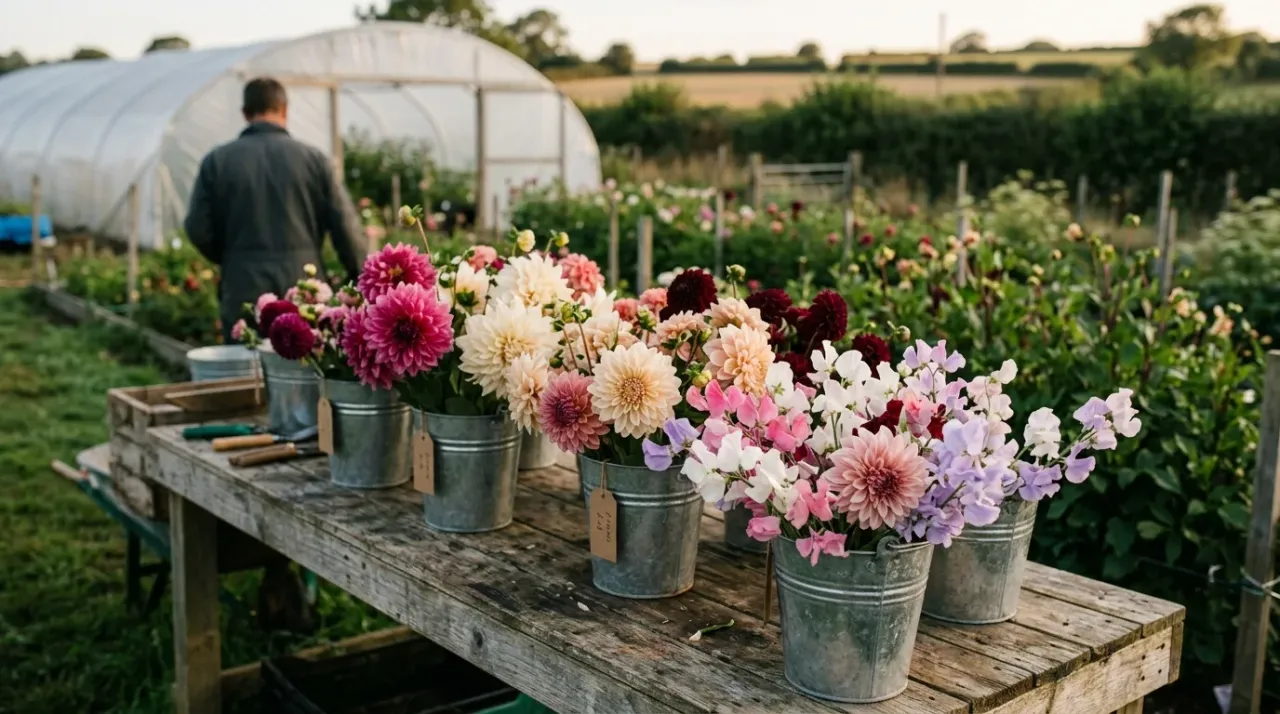
Dahlias. A dahlia barely opens after cutting, so it has to be cut almost fully open, and an open flower bruises and drops in a box. Dahlias last 5 to 7 days in the vase, and every day spent in transit comes off that. It is why they are rare in supermarkets and plentiful on flower farms. Our guide to how long dahlias last goes into the detail.
Sweet peas. Four to five days in the vase, thin stems, petals that crease if you breathe on them. A sweet pea is at its best cut that morning and in a jar by the evening.
Cosmos. Five to six days, and so delicate that the right cut stage is the cracking bud, so the customer sees the whole opening at home.
Garden roses. The scented, many-petalled garden types such as 'Munstead Wood' or 'Gertrude Jekyll' open fast and shatter when they are done. They are a different thing from a tight, long-stemmed florist rose.
These are not niche flowers. They are some of the most loved flowers there are, and the local grower is where people find them.
/ 03
Reason two
The vase life belongs to the customer.
A flower's clock starts the moment it is cut. Every day between the field and the kitchen is a day of vase life the customer never gets.
That is the simplest freshness argument there is, and it is just arithmetic. Here is a worked example with its assumptions shown.
| Cut this morning, sold at the farm gate today | 0 | 7 to 10 |
| Cut, conditioned overnight, sold tomorrow | 1 | 6 to 9 |
| Cut and in transit or storage for three days | 3 | 4 to 7 |
The vase life figure is from published trials; the transit days are illustrations, not measurements of anyone's supply chain. Cool storage slows the clock, but it does not stop it. The point stands on its own: the shorter the journey, the more of the flower's life the customer gets to keep.
/ 04
Reason three
Seasonal flowers tell people what time of year it is.
A local stall changes every few weeks, and that is part of what people are buying.
Tulips and ranunculus in spring. Peonies and sweet peas in early summer. Zinnias, cosmos and sunflowers in high summer. Dahlias until the first frost. A bunch from a local farm is a picture of the season it was cut in, which is something customers notice and come back for. Our UK cut flower calendar shows what is in flower month by month.
It also gives you something new to say every week. "The first sweet peas are in" is news. "Flowers available" is not.
/ 05
Reason four
Scent, shape and varieties you cannot buy elsewhere.
A small farm chooses varieties for beauty and character, not for how they pack.
Scent. Old grandiflora sweet peas like 'Cupani', clove-scented stock, garden roses, chocolate cosmos. Our guide to the most fragrant cut flowers lists 23 of them.
Shape and movement. Wiry stems, nodding heads, trailing amaranth, airy ammi. The flowers that look like a garden rather than a uniform.
Unusual colour. 'Café au Lait' dahlias, 'Earl Grey' larkspur, 'Queen Lime' zinnias, near-black 'Ace of Spades' scabious. Florists come to growers precisely for the colours they cannot order in.
A farm stall is a list of varieties that were chosen because someone loved them.
/ 06
Reason five
You can tell people exactly where it grew.
A local grower can answer every question a customer asks: which bed, which variety, when it was cut, how to look after it. That is worth something in itself, and it builds the kind of trust that turns a single bunch into a weekly order.
/ 07
Saying it
Words that work on the stall.
The case is strong. The trick is to make it in a sentence, without a lecture.
Save this: phrases that sell local flowers honestly.
- "Cut this morning, a mile up the road."
- "These are dahlias. They do not travel, which is why you rarely see them in shops."
- "Sweet peas only last four or five days, so we cut them the day you buy them."
- "This one is 'Café au Lait'. Smell the stock next to it."
- "Next week it will be different. That is the season."
- "Change the water every day or two and recut the stems; it makes a real difference."
And a few things to avoid.
- Claims you cannot back up. Do not quote carbon, import or market figures unless you can name the source and stand behind it.
- Running down other sellers. Customers hear it as defensiveness.
- Over-promising vase life. Sell to the low end of the range, as our vase life guide recommends, and let the flowers surprise people.
The best evidence is the flowers themselves, shown often. A post every week of what was cut, with the variety names, does more than any slogan. BloomOS Farm Studio (on the Farm plan) builds fresh this week posts, price lists and market signs straight from what you logged in the cut log, and can publish them to Instagram and Facebook, so the proof that your flowers are local and seasonal is there every week without a second job at the kitchen table.
From the field
Show customers what you cut this week.
Farm Studio, on the BloomOS Farm plan, turns your cut log into fresh this week posts, price lists and market signs in your farm's own look. Founding farms are free for life.