/ 01
The short answer
A pitch, a plan and a price.
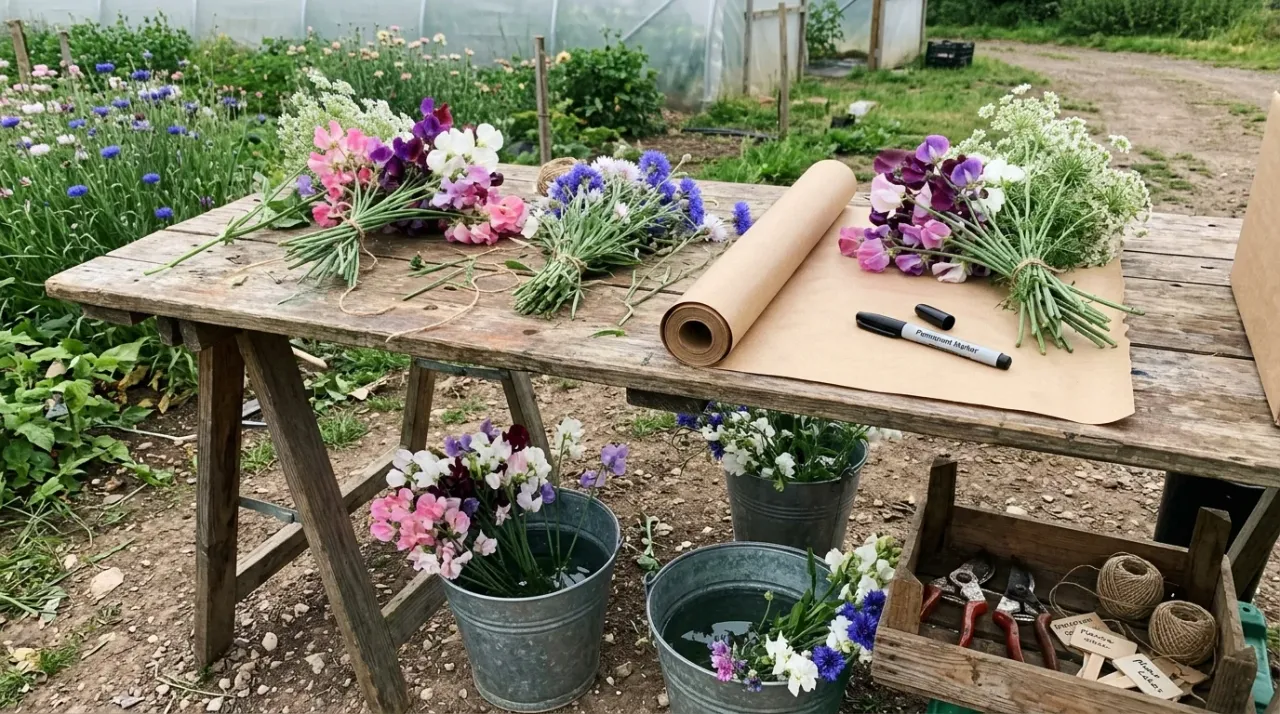
Here's how to sell flowers at a farmers market. You need three things: a pitch at a market that takes growers, enough good bunches for every market day of the season, and a price per bunch that covers the stems, the pitch and your day. Get those right and the stall itself is the easy, enjoyable part.
A farmers market is a good first outlet for a small flower farm. You meet the people who buy your flowers, you're paid on the day, and you find out quickly what sells and what comes home again. The catch is that a market wants you there every market day, rain or shine, all season. So the planning matters more than the display.
A market wants you there every market day, rain or shine. The planning matters more than the display.
/ 02
Getting a pitch
What markets ask for.
Every market sets its own rules, so read the stallholder criteria before you apply. Here are two, to show the kind of thing to expect: a monthly market in West Sussex and a group of weekly markets in Atlanta.
| How often | Third Saturday of the month, 9am to 1pm | Four weekly markets |
| Fees | £49.50 a month for a single pitch, less if you pay months ahead | $50 to apply, then $20 to $30 a week for farmers |
| Who can sell | The stall should be run by someone directly involved in growing | Cut flowers grown on the seller's own farm |
| How local | Within 40 miles, and never more than 100 | Vendors are screened, with locally produced goods the aim |
| Insurance | £5m public liability and £5m product liability | Copies of your licences, certifications and liability insurance at the stall |
| Paying and being paid | Pitch fees paid ahead by bank transfer | You must take debit and credit cards |
| Kit | A pitch of 2 to 2.5 metres | Your own 10 by 10 foot canopy with weights, signs and prices |
Sources: Arundel Farmers' Market criteria and guidance 2025/2026 and Community Farmers Markets, both read on 9 November 2026. Fees change, so check the current page.
Before you apply, have these ready:
- Insurance. Public and product liability at least. Ask the market what level it needs.
- A supply plan. Which flowers you'll have in which weeks, so you can tell the market when you can start.
- Photos of your flowers, and of a stall if you've done one. Markets choose their stallholders.
- A way to take cards, and a float of change.
- The kit: a gazebo or canopy with weights, staging or a table, buckets, and a sign with your farm's name.
/ 03
How to sell flowers at a farmers market
The stall itself.
On the day, the job is to make buying easy. People walk past at a stroll, so the stall has to say three things at a glance: these are fresh, these are local, and this is what they cost.
- Price everything, big and clear. One price per bunch size, written large, saves a lot of questions.
- Use buckets at different heights so the back row shows over the front.
- Keep everything in water and out of the sun. A hot stall shortens vase life, and vase life is your customer's experience of you. Our guide to how long cut flowers last covers conditioning before market day.
- Hold stock back. Keep spare bunches cool and shaded behind the stall and refill as you sell, so the display looks as full at half past twelve as it did at nine.
- Label the flowers. The name of each flower and roughly how long it lasts in a vase answers the questions before they're asked.
- Take names. A sign-up sheet for weekly bunches, wedding enquiries or local florists turns one sale into the next.
Fresh, local, and the price in big letters. Make buying easy.
/ 04
The bunches
Price per stem underneath.
Market bunches are retail, so they're priced differently from a florist's bucket. Work out a price per stem first, then build each bunch to a stem budget. Our pieces on how many stems go in a bunch and how to price cut flowers go through both, and the free stem price calculator does the sum from your own costs.
Here's a market day worked through, so you can see where the money goes. Every number is an assumption except the pitch fee, which is Arundel's monthly single pitch.
| 30 bunches of 10 stems, sold at £10 each | 300.00 |
| Pitch fee | −49.50 |
| Growing cost of 300 stems at 16p (the stem price calculator's starting figure for cosmos) | −48.00 |
| Your market day: 8 hours at £15 an hour | −120.00 |
| Left, before fuel, card fees and wrapping | 82.50 |
That £82.50 is what's left after paying yourself a wage for the day. It's thin, which is why three things matter: selling out, so nothing comes home; the price, which can go up if you're sold out by ten; and the second sale, the weekly bunch or florist order you pick up at the stall.
/ 05
Supply
Enough for every market day.
A stall that's full in July and half-empty in June is hard to build regulars on. The planning job is a steady supply: 30 bunches of 10 is 300 stems a week, every week, from your first market to your last.
Work it back from the market dates:
- List your market days, and count the weeks from the first to the last.
- Choose a mix for each part of the season: something focal, something filler, something green. Early sweet peas and snapdragons give way to cosmos, zinnias and sunflowers, then dahlias to the frost.
- Space your sowings so a new batch comes into flower as the last one fades. The free succession planting calculator shows the stems you'll have each week.
- Plan a home for the surplus. High summer gives more than one stall can sell. A florist or two can take it, and our guide to selling to florists covers how to start.
/ 06
Questions
What growers ask.
How much can you make selling flowers at a farmers market?
It depends on your prices and how much you sell. In our worked example, 30 bunches at £10 bring in £300, and after the pitch, the stems and a £15 an hour wage for the day, about £82 is left before fuel and card fees.
Do you need insurance to sell flowers at a farmers market?
Check your market's rules before you apply. Arundel's market asks every stallholder for £5m of public liability and £5m of product liability cover, and the Atlanta markets ask vendors to keep copies of their liability insurance at the stall.
Can I sell flowers I didn't grow at a farmers market?
Not at the two markets we looked at. Arundel's rules say the stall should be run by someone directly involved in production, and the Atlanta markets accept cut flowers grown on the seller's own farm.
Do I need to take card payments at a market stall?
Some markets insist on it: the Atlanta markets require vendors to take debit and credit cards. Even where it isn't a rule, a card reader means you don't lose a sale when someone has no cash.
When should I apply for a market stall?
As early as you can, once you know which weeks you'll have flowers. Have your insurance, a supply plan and a few photos ready when you apply.
From the field
Every market day, counted.
BloomOS logs every cut in the field, even with no signal, so you know what you've cut for market day, and keeps your customers, orders and invoices in one place. The Seedling plan is free for ever.