/ 01
The short answer
Start from stems, not acres.
How much land you need for a flower farm depends on what you want to sell, and it's usually less than people expect. Work it back: the stems you'll sell each week, the beds that give them, then the paths and everything else around the beds.
The Washington flower farm Floret wrote in 2015 that it had "just two tiny acres dedicated to flower production", and that most of the farms in the seasonal flower movement "are actually under five acres" (Floret). The same post describes a Toronto micro-farm on a sixteenth of an acre, spread across nine or more back gardens, that supplied five florists a week, ran a subscription and did about a dozen weddings a year.
The useful question isn't how many acres. It's how many stems a week.
/ 02
One bed
What a bed gives in a season.
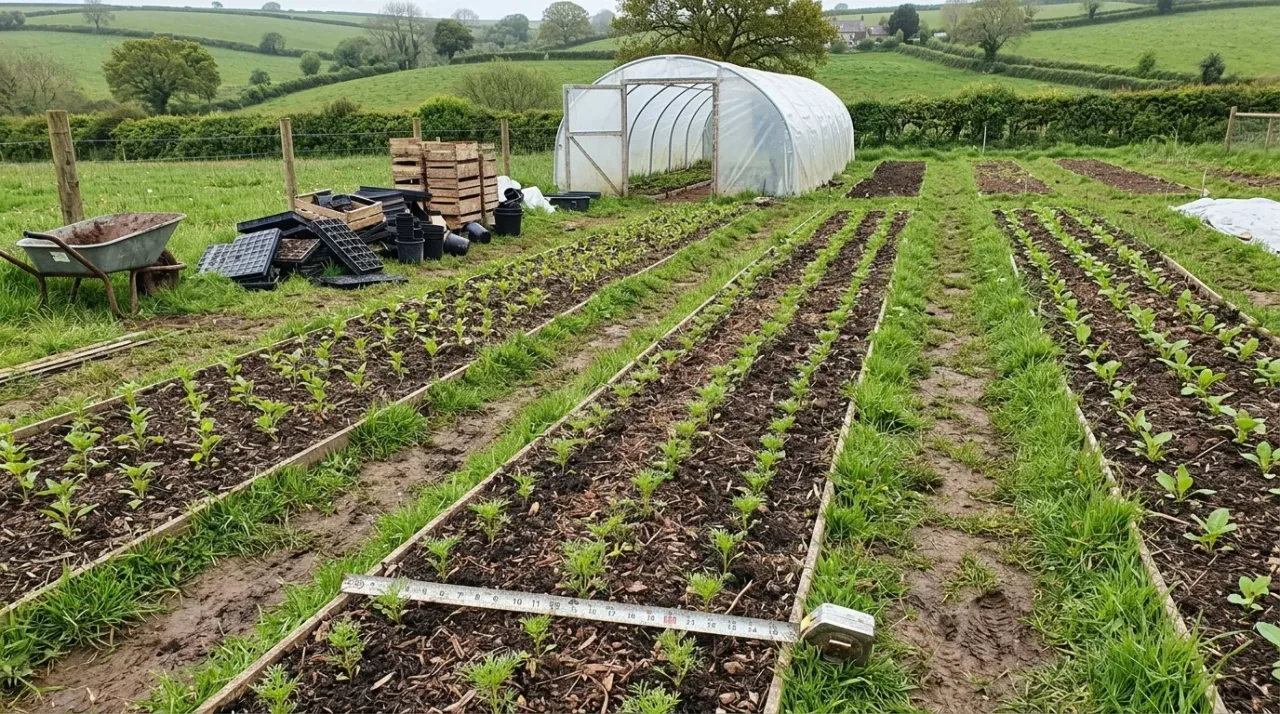
Most cut flower beds are about 1.2 metres wide, so you can reach the middle from either side. Here is what one 10 metre bed gives at a typical cutting spacing, using the starting figures for stems per plant in our free plants per bed calculator:
| Cosmos at 30 cm | 132 | about 30 | about 3,960 | about 11 | about 360 |
| Zinnias at 23 cm | 215 | about 15 | about 3,225 | about 10 | about 320 |
| Snapdragons at 15 cm | 528 | about 6 | about 3,168 | about 5 | about 630 |
| Single-stem sunflowers at 15 cm | 528 | 1 | 528 | about 2 | about 260 |
| Ammi at 30 cm | 132 | about 10 | about 1,320 | about 5 | about 260 |
| Dahlias at 45 cm | 44 | about 20 | about 880 | about 12 | about 70 |
Those are starting figures for a well-cut bed, and real beds vary. In the North American growers' trials run by the ASCFG and summarised for UK growers by AHDB, snapdragons averaged about five stems a plant and one celosia about seven (AHDB review, 2013). Our plants per bed piece explains the spacing behind each line.
Treat the table as a good season, not a promise.
/ 03
How much land do you need for a flower farm
Work back from your sales.
Here's the sum for one weekly market stall. Every number is an assumption to swap for yours. Say you want 30 bunches of 10 stems every Saturday for 16 weeks: 300 stems a week, 4,800 in the season.
A mixed bunch needs a focal flower, a filler and some green, and the stall needs something to cut every week from the first market to the last. So rather than dividing 4,800 by what one bed gives, plan which beds are cutting in each part of the season:
| Snapdragons | 1 | Early summer |
| Ammi, in two sowings | 1 | Early to midsummer |
| Cosmos, in two sowings | 2 | Midsummer into autumn |
| Zinnias | 1 | Midsummer into autumn |
| Single-stem sunflowers, a quarter of the bed sown each fortnight | 1 | Mid to late summer |
| Dahlias | 1 | Late summer to the frost |
| Foliage and perennials | 1 | All season |
| Total | 8 |
Eight beds of 10 by 1.2 metres is 96 square metres of growing space. Add a 60 cm path beside each bed and a little room at the ends, and call it 20 square metres a bed: about 160 square metres, or roughly a twenty-fifth of an acre.
On paper those eight beds give far more than 4,800 stems, and that's deliberate. The spare in high summer covers the bad weeks, and it can go to a florist or two. The free succession planting calculator shows the stems you'd have each week from a plan like this.
/ 04
More than beds
What else needs room.
The bed maths is the smallest part of the land. Farms grow into more space than the sum suggests, and for good reasons:
- Successions and rotation. Dahlias and autumn-sown snapdragons take a bed for months before they give a stem, and you'll want to move crops around from year to year.
- A tunnel or two, for earlier and later flowers and for crops that hate the wet.
- Foliage and shrubs: eucalyptus, pittosporum, hedging and perennials that hold their ground for years.
- Somewhere to work: a shed or barn for conditioning and bunching, a cool place to keep stems, water, compost bays, and a way to get a car to the door.
- Room for a bad year. Slugs, drought or a wet June will take some beds, and spare ones keep the stall full.
Once you know your stems per bed, the money can be worked out the same way. Published US figures put cut flower sales at roughly $25,000 to $60,000 an acre a year, and our profit per acre piece works through what one bed contributes, with every assumption shown.
The bed maths is the smallest part of the land.
/ 05
Grow into it
Start small, count, then add beds.
The safest way to find your own number is to start smaller than you'd like and count everything. Log what each bed gives in its first season, stem by stem, and next winter's plan uses your figures instead of ours.
That counting is what BloomOS is for: a cut logged in the field in seconds, even with no signal, against the bed it came from, so yield per bed and profit per variety add up as you go. The Seedling plan is free for ever, with no card.
/ 06
Questions
What growers ask.
How much land do you need to start a flower farm?
You can start on far less than an acre. In our worked example, eight 10 metre beds on about 160 square metres could supply a weekly 30-bunch market stall at our calculator's starting figures, and Floret has written that most seasonal flower farms are under five acres.
How many stems does one bed of flowers give?
At our calculator's starting figures, a 10 by 1.2 metre bed gives about 3,960 cosmos, 3,225 zinnias or 880 dahlia stems in a season. Trial averages can be lower, so use your own numbers after the first year.
How big is an acre in flower beds?
An acre is about 4,047 square metres. If each 10 metre bed and its share of path takes about 20 square metres, that's around 200 beds on paper, before the shed, the tunnels and the tracks.
Can you start a flower farm in a back garden?
Yes, on a small scale. Floret describes a Toronto grower farming a sixteenth of an acre across several back gardens and supplying five florists a week, so start with the space you have and count what it gives.
How much land do you need to make a living from flowers?
There's no single answer, because it depends on your prices, your channels and how much of the work you pay for. Our profit per acre piece shows how to work out what one bed contributes, which is the number to scale up from.
From the field
Plan the beds before the land.
Our free crop planning spreadsheet turns a list of crops into beds, sowings, a seed order and profit per bed. When you're growing, BloomOS keeps your beds on a map with what each one cuts.