/ 01
Why grade
The right stem, to the right buyer, at the right price.
Every bucket that comes in from the field has a spread in it. A few stems are perfect: long, straight, clean and at exactly the right stage. Most are good. Some are short, bent or marked, and a handful are only fit for the drying rack or the compost.
If they all go out at one price, two things happen. Your best stems are sold too cheaply, and your weaker ones disappoint the customer who paid for the best. Grading fixes both, and it does not need a packhouse or a grading table. It needs four words everyone on the farm agrees on.
Grading is not about being fussy. It is about never selling a wedding stem at a jam jar price, or a jam jar stem to a bride.
/ 02
The four grades
Write them down once.
Most small farms need four grades, no more. These are the ones BloomOS uses, and the kind of stem that belongs in each.
| Premium | Your longest, straightest stems at the ideal stage, with clean foliage and no marks | Weddings, events and florists' focal flowers |
| Grade 1 | Good length and form, a small flaw at most | Florist buckets, market bunches, subscriptions |
| Grade 2 | Shorter, a slight bend or a mark, still fresh and sound | Mixed jam jars, farm gate bunches, workshops |
| Seconds | Too short, bent or marked to sell as cut stems | Drying, your own arrangements, the compost |
The words matter more than the table. Write your own version for each main crop, with a stem length in centimetres where it helps, because a Premium sweet pea and a Premium dahlia are not the same length. Pin it on the shed wall where the buckets are filled.
What to put on the card for each crop:
- the stem length for Premium and for Grade 1, in centimetres;
- the stage to cut at, in your own words;
- the flaws that drop a stem a grade, such as a bend, a mark or a weak neck;
- which bucket each grade goes in, if you use more than one.
/ 03
At the bed
Grade as you cut, not afterwards.
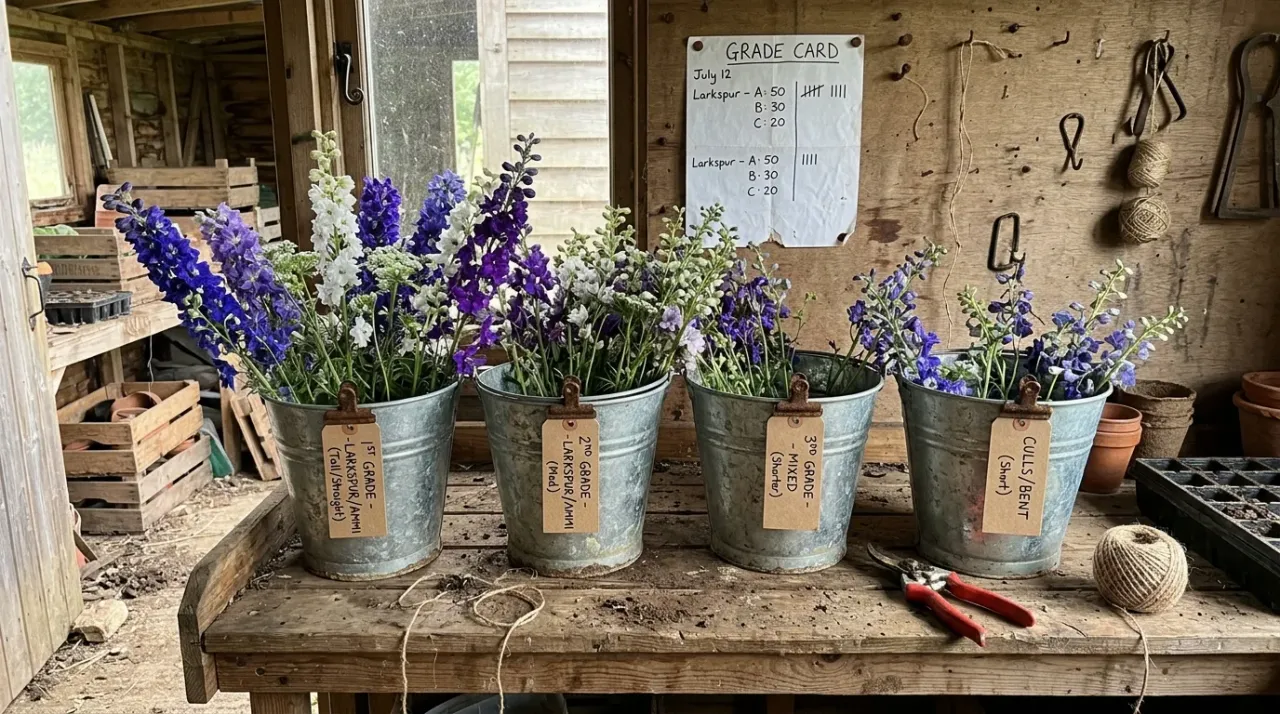
The easiest place to grade is the moment you cut. Take a bucket for each grade you expect, or one bucket and a separate bunch for the obvious Premium stems, and sort as you go. Grading later on the bench means handling every stem twice.
Three habits keep it consistent:
- Keep a reference stem. On the first morning of a crop, cut one stem of each grade and stand them in a jar by the door. Anyone unsure can hold a stem up against them.
- Grade together for the first week. If two people cut, work side by side for the first few mornings and talk through the stems you disagree on. After that you will agree without talking.
- When in doubt, grade down. A florist who finds a Grade 1 stem in a Premium bucket remembers it. Nobody complains about a lovely stem in the Grade 1 bucket.
/ 04
Pricing
Price each grade on purpose.
Once stems are graded, give each grade its own price instead of one price for everything. Premium stems carry the most care and the most risk, so they should earn the most. Seconds may earn nothing as cut stems but still pay their way as dried bunches or workshop material. If you sell by the bunch, give each grade its own stem count too: our guide to how many stems go in a bunch is a good place to start.
If you have not worked out prices from your own costs yet, our guide to pricing cut flowers starts from the cost of a stem and builds up from there.
/ 05
The season
What the grade mix tells you.
The real value of grading comes at the end of the season. Record the grade with each cut and you can see, for every variety and every bed, how much came out Premium and how much went to Seconds.
That answers questions a stem count cannot. A variety that cuts heavily but rarely makes Premium may be worth less than a lighter cropper that is almost all wedding grade. A bed whose stems always come in short may need more feeding, more water or a different variety next year. The grade mix turns a hunch about what grows well into something you can plan from.
Count the stems and you know what you grew. Grade them and you know what was worth growing.
/ 06
Questions
What growers ask.
How do you grade cut flowers on a small farm?
Agree four grades, write down what goes in each for every main crop, and sort stems into them as you cut. Premium, Grade 1, Grade 2 and Seconds cover almost every stem a small farm sells.
What makes a Premium cut flower stem?
A long, straight stem cut at the right stage, with clean foliage and no marks. Set a length for each crop, because a Premium sweet pea is much shorter than a Premium dahlia.
When is the best time to grade cut flowers?
At the bed, as you cut. Grading later on the bench means handling every stem twice, and it is easier to be consistent with the plant in front of you.
Should each grade have a different price?
Yes. Premium stems carry the most care and the most risk, so price them highest, and give Grade 1 and Grade 2 their own prices rather than one price for everything.
What can you do with Seconds?
Dry them, use them in your own arrangements or workshops, or compost them. Count them either way, because a variety that makes a lot of Seconds is telling you something.
From the field
Grade as you cut.
BloomOS records Premium, Grade 1, Grade 2 or Seconds with every cut, with a default for your farm, so the grade mix for each variety is there at the end of the season.