/ 01
The business case
Why dried flowers belong in your wedding offering.
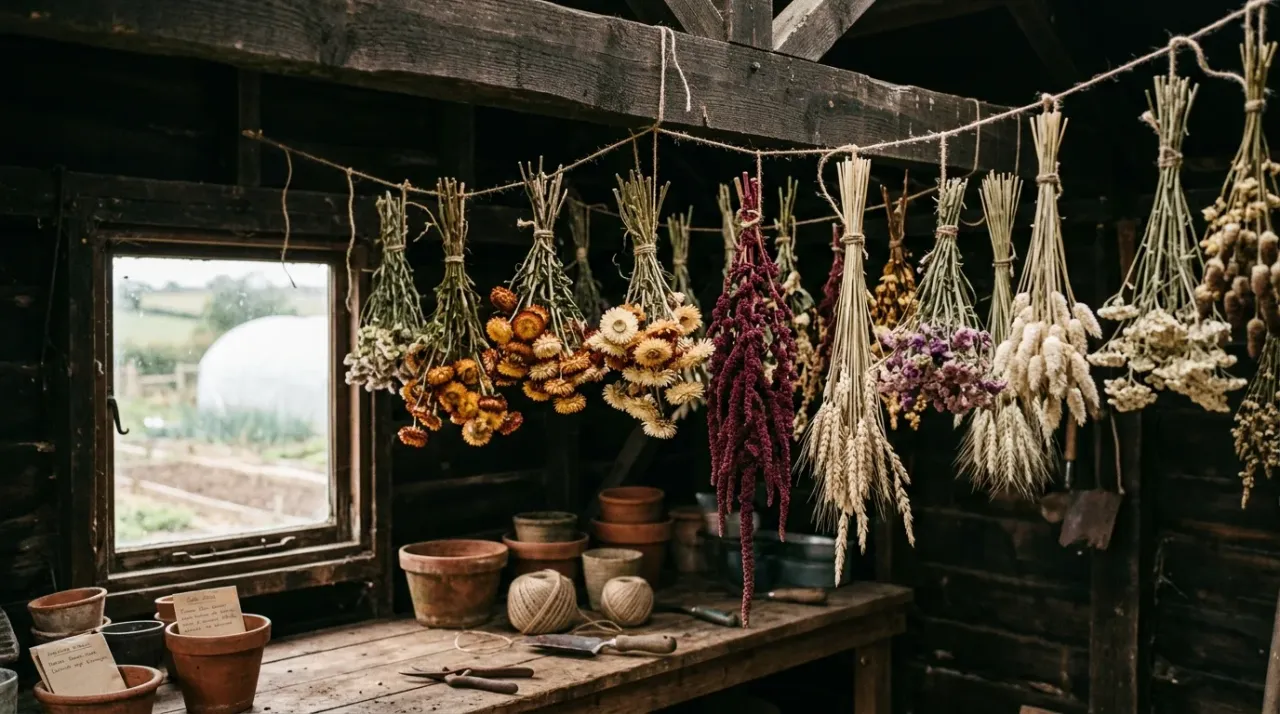
Dried flowers aren't a fallback. They're a genuine revenue stream that fits neatly alongside your fresh work. Here's why they make sense for small-scale growers.
Couples want keepsakes. A growing number of brides ask for something they can keep. Dried bouquets don't wilt on the honeymoon; they sit on a mantelpiece for years. That emotional value lets you charge accordingly.
Lower stress, better cashflow. Fresh wedding work means cutting, conditioning and delivering in a single fraught window. Dried lets you prep in the quiet months and deliver when summer gets busy. You're not scrambling; you're pulling from stock you made in October.
Dried fills gaps when fresh fails. A heatwave, a drought, an early frost: any of these can wipe out a week of fresh cuts. A stash of dried stems means you still have something beautiful to offer when the field lets you down.
"The stems you cut this month don't have to sell this month."
/ 02
What to cut now
October stems that dry beautifully.
Not everything dries well, and not everything that dries well suits weddings. Focus on stems that hold their colour, shape and texture through months of storage.
Everlastings are the obvious starting point. These are bred for drying and reward very little effort:
- Strawflowers (cut when outer petals are open but centre is still tight)
- Statice in whites, purples and apricots
- Ammobium, the underrated workhorse
- Gomphrena, especially the 'QIS' series
Grasses add movement and neutrals that wedding designers love:
- Bunny tails (Lagurus ovatus), best cut before they shed
- Panicum, left to mature on the stem
- Pampas, if you grow it and can cut before wind shreds the plumes
Seedheads bring texture and architectural interest:
- Nigella pods, striped and sculptural
- Scabiosa stellata, the drumstick seedhead
- Poppy pods, fully dried on the plant
- Honesty (Lunaria), once you've rubbed off the outer casings
| Strawflower | Outer petals open, centre tight | Stems weaken when dried; wire if needed |
| Statice | Fully coloured, before rain | Colours hold well for 12+ months |
| Ammobium | Petals bright white | Avoid cutting after heavy dew |
| Gomphrena | Heads firm and round | Stems stay strong |
| Bunny tails | Before shedding | Cut whole clumps, not singles |
| Nigella pods | Fully formed, striped | Remove any remaining petals |
| Honesty | Pods papery | Rub off outer casing to reveal silver |
/ 03
How to dry
Methods that preserve colour and shape.
Most wedding-worthy stems need nothing more than a warm, dry space and a bit of patience. But some blooms repay extra effort.
Hang-drying works for nearly everything. Strip lower leaves, bundle loosely (five to ten stems), secure with a rubber band, and hang upside down. The key variables are airflow and humidity. A boiler cupboard, a dry shed with good ventilation, or a heated polytunnel in autumn all work. Avoid damp outbuildings where stems will mould before they dry. Most everlastings are ready in one to three weeks; grasses may take a little longer.
Silica gel is worth it for delicate blooms. If you want to offer dried garden roses, zinnias or dahlias, silica preserves colour and shape far better than air-drying. Bury the bloom face-up in silica crystals, seal the container, and leave for five to seven days. It's fiddly and the gel needs recharging between batches, but the results photograph beautifully and command higher prices.
Glycerine keeps foliage supple. Eucalyptus, beech and oak leaves can be preserved in a mixture of one part glycerine to two parts hot water. Stand stems in the solution for one to three weeks until leaves feel soft and slightly waxy. Glycerine-preserved foliage won't shatter the way air-dried leaves do, making it far easier to handle in arrangements.
"A stash of dried stems means you still have something beautiful to offer when the field lets you down."
/ 04
Storing through winter
Keeping dried flowers in selling condition until summer.
Dried flowers are only an asset if they survive until you need them. Poor storage turns a winter's work into dusty, faded waste.
Dark, dry, and away from mice. Light fades colour. Damp invites mould. Mice will shred anything soft for nesting material. A spare bedroom, a dry loft, or sealed plastic crates in an unheated but weatherproof shed all work. Avoid garages with fluctuating temperatures or sheds where rodents have the run of the place.
Boxing versus hanging. Hanging keeps stems straight and lets you see what you have, but takes space and exposes blooms to light and dust. Boxing protects colour and keeps things tidy, but risks crushing delicate heads. A practical compromise: box the sturdy stuff (statice, ammobium, grasses) and hang the sculptural pieces (nigella pods, strawflowers) in a dark cupboard.
Labelling matters more than you think. By June, you won't remember which shade of pink that bundle is or when you dried it. Label every box and bundle with variety, colour and date. If you're using BloomOS, you can log dried inventory in your cut log so it shows up alongside your fresh availability when you're quoting for weddings.
/ 05
Selling into weddings
How to position dried flowers to couples.
Dried flowers are a different product with a different pitch. Get the positioning right and they sell themselves.
Dried as accent versus all-dried arrangements. Some couples want a fully dried bouquet for the keepsake factor. Others want a fresh bouquet with a few dried touches for texture. Offer both options explicitly. A mixed approach also lets you use dried to stretch fresh when supplies are tight.
Pricing should reflect the true cost. It's tempting to price dried cheaply because the stems are "already done." But you've stored them for months, handled them twice, and taken on the risk of spoilage. Price in:
- The original cost of growing and cutting
- Storage space and materials (boxes, labels, silica)
- Handling time at packing
- A margin for loss (some stems won't make it)
As a worked example: if you cut 200 strawflower stems in October, lose 15% to breakage or fading, and spend 30 minutes boxing and labelling, your effective stem count is 170 and your labour cost is spread across those. Price accordingly.
Show samples early. Couples book months ahead. Build a sample box of your best dried stems and photograph them in good light. Use those images in mood boards, on your website, and in consultations. If you use Farm Studio, you can pull variety images and descriptions straight into social posts and price lists without recreating everything from scratch.
/ 06
Questions
Dried wedding flowers FAQ.
How far in advance can I dry flowers for summer weddings? Stems dried in October and stored properly will last through to the following summer with minimal fading. Everlastings like strawflowers and statice hold colour for 12 months or more. Silica-dried blooms are more fragile and best used within six to nine months.
Do dried flowers need any conditioning before use in arrangements? Unlike fresh stems, dried flowers don't need water or conditioning. However, you may need to steam gently over a kettle to relax petals that have crushed in storage, or wire weak stems (particularly strawflowers) for stability in bouquet work.
Can I sell dried flowers alongside fresh at farmers' markets? Absolutely. Dried bunches make excellent add-on sales and catch the eye of shoppers who want something longer-lasting. Keep them out of direct sunlight at the stall to prevent fading, and consider offering small "everlasting posies" at a lower price point than your fresh buckets.
From the field
Run your farm from your phone.
BloomOS logs every cut in the field, even when the signal drops, and turns it into orders, invoices and the numbers behind next season. Free to start, built by a flower farmer.